



Although I grew up in Enfield and had visited Trent Country Park to see the daffodils in spring, I had no idea of its history. Its WW2 history was not made public until the end of the Cold War, but now, all is revealed in a new museum, The House of Secrets in Trent Park Mansion.
Trent Park was originally part of the ancient royal hunting forest of Enfield Chase. 200 acres (80 ha) of it was granted to King George III’s physician, Dr Richard Jebb, as a reward for going to Trento (hence the name Trent Park), in the Austrian Tyrol, to care for the king’s younger brother, the Duke of Gloucester (who may have had porphyria). Dr Jebb had an exquisite pavilion with 3 reception rooms and 3 bedrooms built, designed by Sir William Chambers. The land was landscaped by Sir Humphry Repton. In C20, Sir Philip Sassoon added 3 C18 monuments – The Duke’s Pyramid, The Emma Crewe ‘Pineapple’ and Sassoon’s Obelisk aka ‘The Vista’ – which he purchased from Wrest Park, Beds. These monuments are clearly visible, but apart from the lakes and lime tree avenue, much of Humphry Repton’s landscaping is currently obscured by several building sites during the construction of 235 flats. You can download a map of Trent Country Park here.
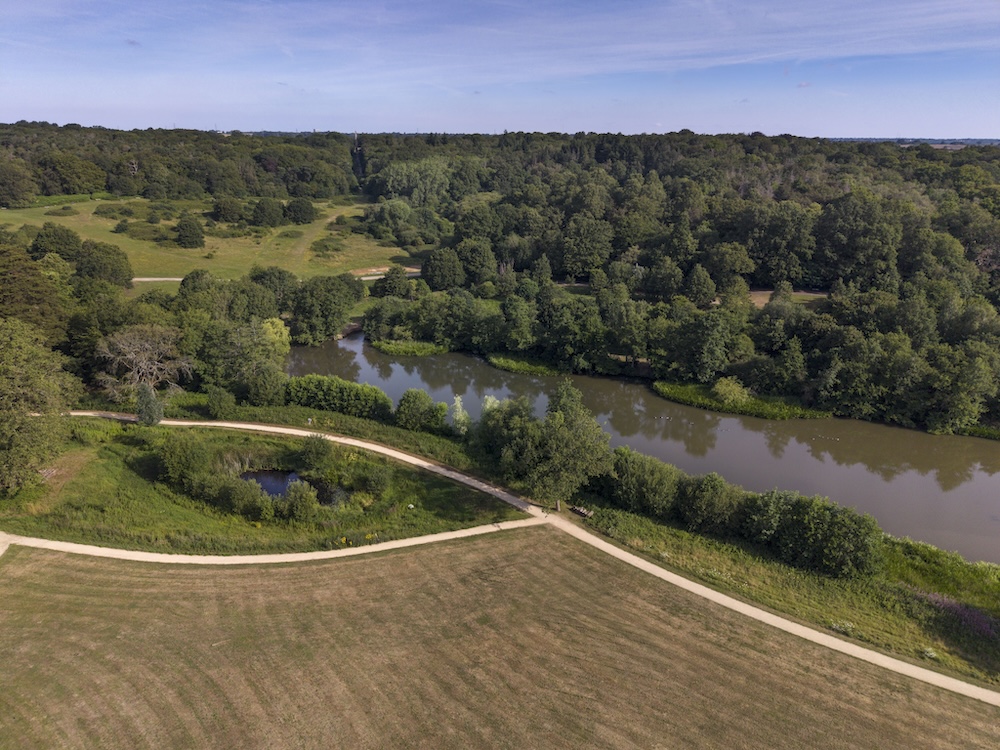 Aerial view of Trent Park © James O. Davies. Photo Credit: © Trent Park Museum Trust.
The Mansion in Trent Park was the country home of Sir Philip Sassoon MP (cousin of the poet Siegfried Sassoon), who had inherited the 900-acre (364 ha) estate from his father in 1912. Sir Philip had a reputation as one of the greatest hosts in Britain. Guests included Sir Winston Churchill, Sir Anthony Eden, George Bernard Shaw, Lord Balfour, Queen Mary, King Edward VIII, the Duke of Kent, King George VI, Queen Elizabeth and their daughters Elizabeth and Margaret, Charlie Chaplin, Fred Astaire and Lawrence of Arabia. After Sir Philip’s death in 1939, Trent Park was requisitioned as an interrogation centre for enemy airmen. Much of the furniture was moved to Houghton Hall, the magnificent country estate in Norfolk of the Marquess of Cholmondeley, who was married to Sir Philip’s sister Sybil.
At the outbreak of WW2 MI6 spymaster Col. Thomas Kendrick arrived at the Tower of London to set up a top secret operation: German prisoners’ cells were to be bugged and listeners installed behind the walls to record and transcribe their private conversations. This mission proved so effective that it would go on to be set up at 3 further sites—and provide the Allies with crucial insight into new technology being developed by the Nazis. The rooms at the Mansion at Trent Park were equipped with hidden microphones that allowed “Listeners” to listen in to the pilots’ conversations. Cables were laid, and bugs hidden behind skirting boards and stucco rosettes, under park benches, in flower pots, at the billiard table and in their bedrooms. Most slept two to a room, so that they could chat. The information obtained included the German pilots’ views on the relative strengths and weaknesses of German aircraft.
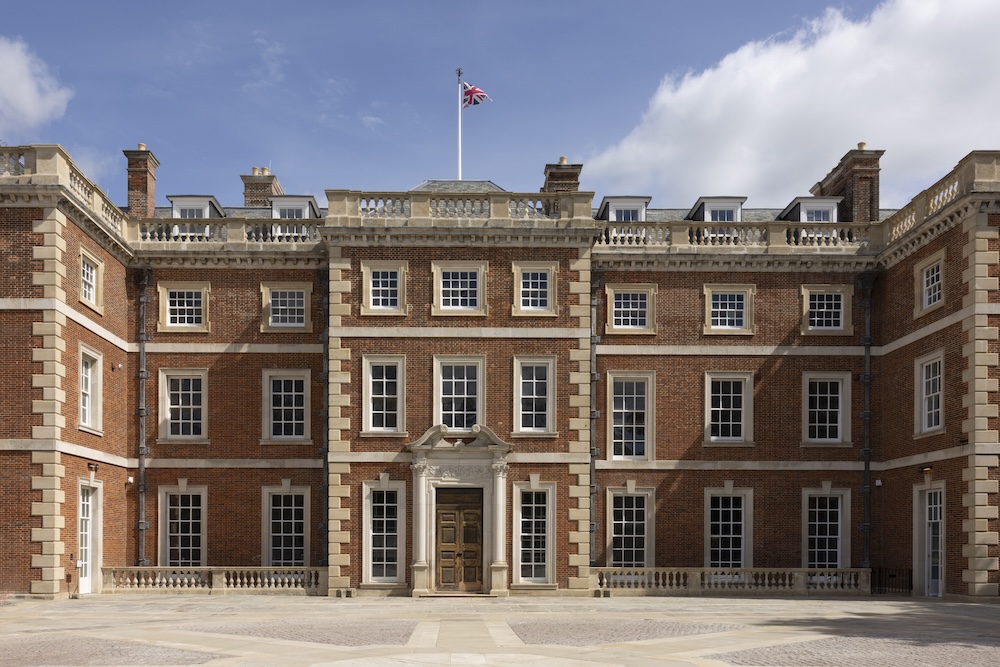 Exterior of Trent Park House of Secrets. Photo Credit: © Ruth Board.
The microphones, installed by GPO engineers from Dollis Hill, were made by the Radio Corporation of America (RCA). In 1945, the engineers returned and stripped out the entire system. Hardly anything about this reached the public until the German historian Sönke Neitzel published his edition of the wiretapping protocols about 20 years ago. Although the high-ranking officers who arrived at Trent Park from 1942 onwards revealed in their unfiltered conversations, among other things, that they knew about the atrocities on the Eastern Front, these confessions were withheld from the Nuremberg court as evidence because the British did not want to reveal their wiretapping methods. Later in the war, the estate was used as a special prisoner-of-war camp, the ‘Cockfosters Cage’ for captured generals and a number of lower-ranking staff officers. In total, 84 were brought to Trent Park. To put them at ease and off guard, they were treated hospitably, provided with special rations of whisky, allowed regular walks on the grounds and even taken to expensive London restaurants.
The hidden microphones and listening devices allowed the British military (MI19) to gather important information and an intimate insight into the minds of the German military elite, their political views, and the resistance in Germany that led to the attempt to assassinate Hitler. An example of intelligence gained was the existence and location of the German rocket development and one of the major launch sites of the V2 rockets at Peenemünde Army Research Centre, when General von Thoma discussed what he had seen there. This led to the area being targeted for a heavy bomber attack by the RAF.
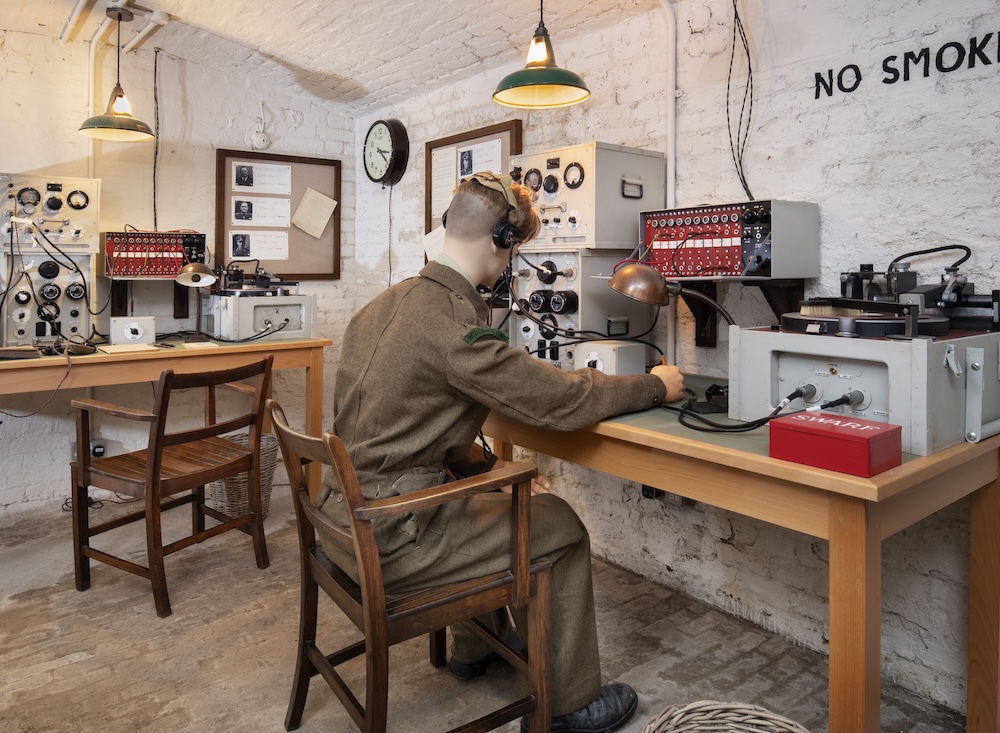 Trent Park House of Secrets, Basement M Room. Photo Credit: © James O. Davies.
The Secret Listeners: At first, M (‘Miked’) room operatives were all British German-speakers, but it was soon realised that those with an academic knowledge of German could not always understand the slang and jargon used in the prisoners’ conversations. So from 1942, refugees from Germany, Austria and Czechoslovakia, all but one of whom were Jewish, who spoke German as a first language, were employed as listeners. Many had been rounded up at the start of the war as ‘enemy aliens’. When they were recruited for MI19, they were delighted to be doing something positive to help win the war. Around 40 secret listeners were stationed at Trent Park and another 60 at its sister sites, Latimer House and Wilton Park. In all, nearly 1,000 people worked for MI19. The work was very concentrated, intensive and extremely secret. Many operators never disclosed what they did at Trent Park.
Listeners included: Ernst Lederer, comedian Helen Lederer’s grandfather Brin Newton-John, father of future Grease actress Olivia Fritz Lustig, father of BBC journalist and radio broadcaster Robin Lustig Eric Mark, Blue Badge guide Anne Mark’s father. In a speech at the launch of Dr Helen Fry’s book “The Walls Have Ears” in 2019, Eric Mark, age 97, recalled how, during 12-hour shifts, long stretches of boredom were interspersed with desultory conversations during which Nazi officers sometimes boasted about how many Jews or other undesirables they had killed. Only after the Archives were released in 2010 did the Secret Listeners learn how important their work had been.
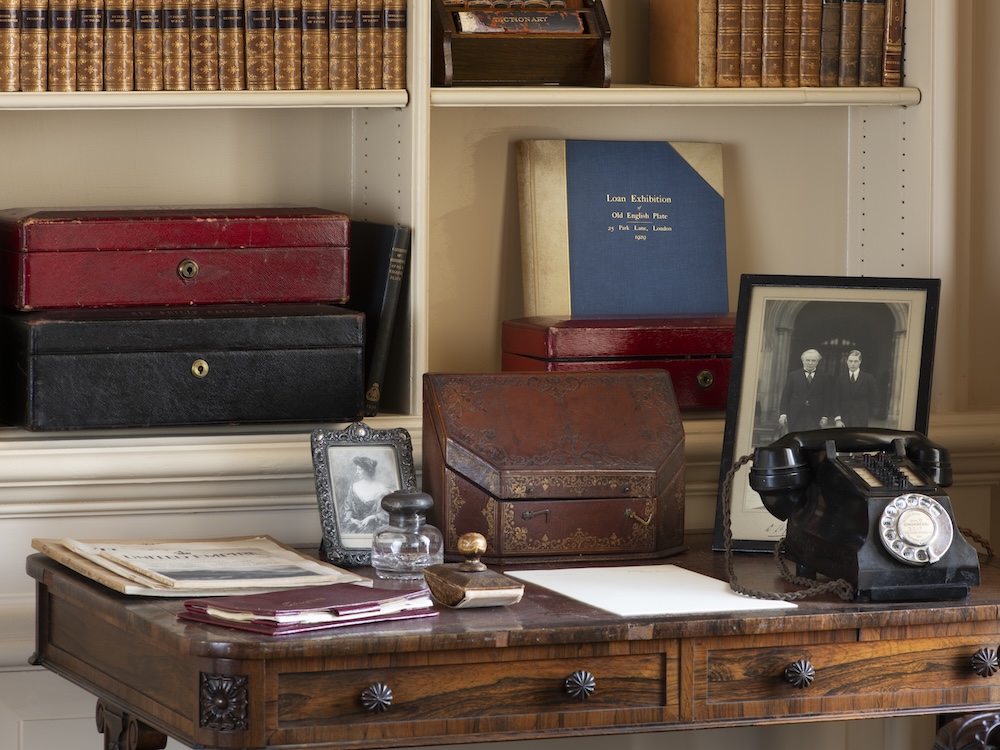 Trent Park House of Secrets, desk in the library. Photo Credit: © James O.Davies.
After the War: 1947-2012 Trent Park was a teacher training college, becoming part of Middlesex University. Trent Country Park opened to the public in 1973. The estate was then sold to Berkeley Homes, who are building 235 flats and converting all but the ground floor and basement of The Mansion into flats. In 2014, the Save Trent Park campaign was launched by then local councillor and lawyer Jason Charalambous to secure future public access to the house and to share its extraordinary history with the public. The campaign received widespread public support from local residents, generous individuals and many charitable trusts and foundations.
In 2016, after 2 years of sustained campaigning—including active involvement from former secret listeners Eric Mark and Fritz Lustig —the principle of a museum was enshrined in Berkeley Homes’ planning application for redevelopment, and the Trent Park Museum Trust was established. In 2025 the current Marquess of Cholmondeley, Sassoon’s great-nephew, lent the museum memorabilia, paintings and many of the original furnishings bought for the house in the 1920s and 1930s, including chinoiserie chests and vases. He also contributed his taste and experience as a member of the Board of Trustees.
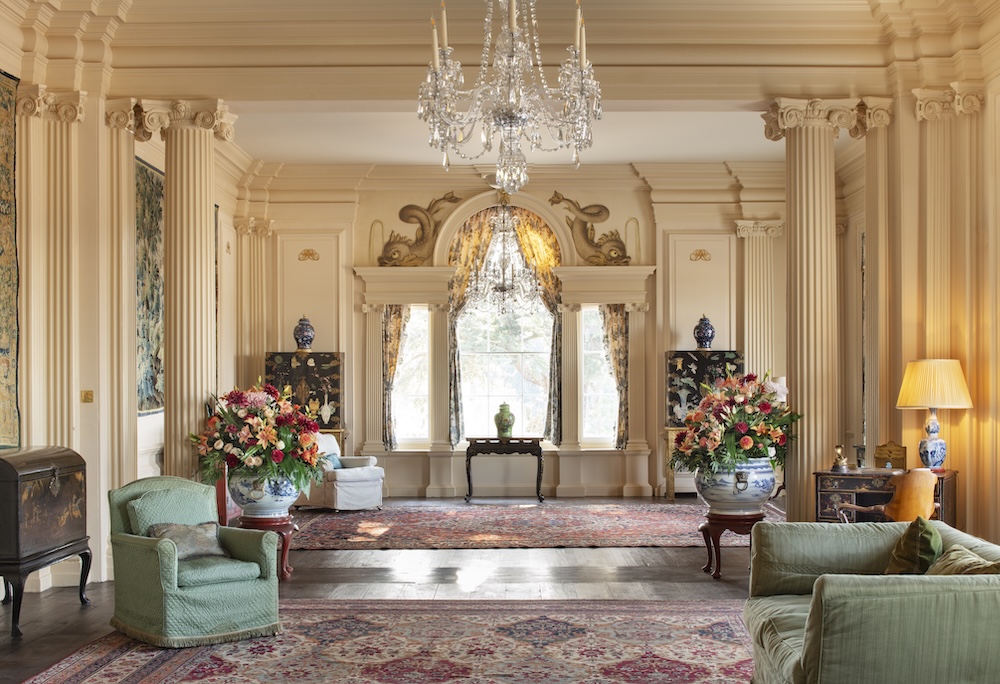 Trent Park House of Secrets, the Drawing Room with Rex Whistler’s murals flanking the Venetian windows. Photo Credit: © James O. Davies.
At auctions and in archives, the curators discovered contemporary machines and movable objects – from furniture to fire extinguishers to light switches. The Trent Park House of Secrets opened in July 2026. The Museum: You enter on the ground floor, where you are greeted by one of the many enthusiastic, knowledgeable volunteers. The rooms have been impressively restored, based on old photographs and research. They reveal the parallel worlds of the house—the luxurious setting for the get-togethers of the high society and the spartan quarters in which the shift workers, all except one Jewish refugee who had fled Hitler, recorded conversations of the German staff officers. Original Murals by “Rex” Whistler in the drawing room, salon, library and what is now the cafe have been restored.
The exhibition in the basement shows the life of the “Listeners”. The recording machines—disk cutters—had been developed by the BBC from 1938 and the first so-called ‘Model C’ units were supplied to the army in 1940. They had 3 components: an amplifier, a power unit and the disk-cutting machine itself. The recording machine could use 10, 12 or 13-inch discs with a speed of 78 rpm. Each disk held up to 7 minutes of conversation. Although the disks used were referred to as ‘acetates’ the lacquer was in fact cellulose nitrate such as was then used in cinema film. Cutting the cellulose lacquer produced a thin ribbon of offcut, or ‘swarf’ which was removed by a brush on the turntable. Although the cellulose nitrate was safe as a lacquer, when the swarf was mixed with air it became highly inflammable. Smoking was banned in the M rooms.
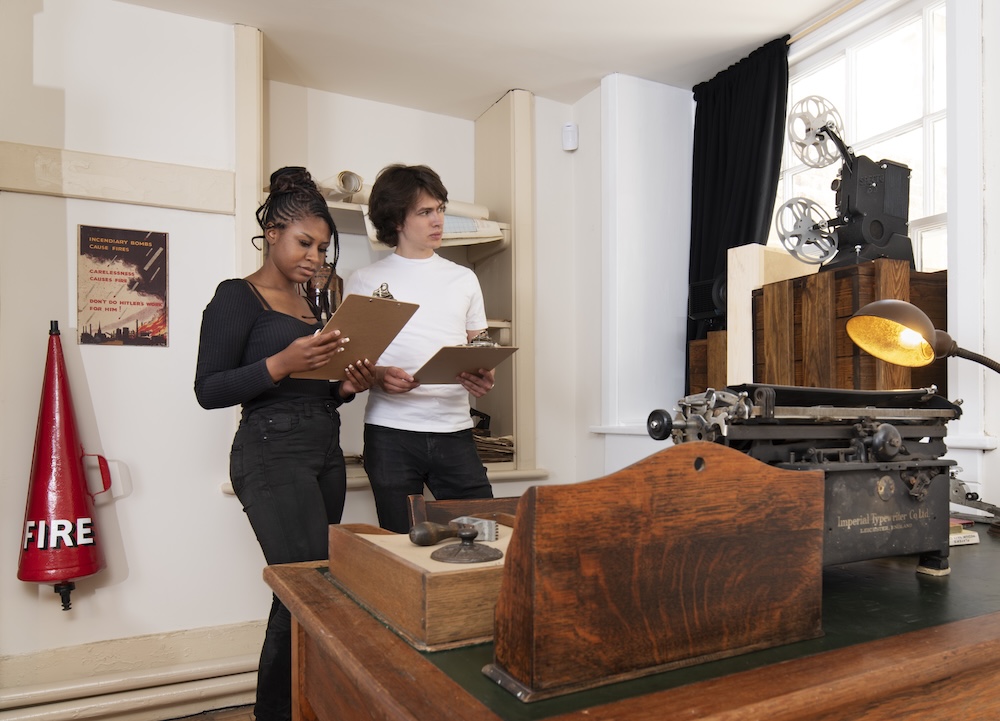 Visitors in the basement rooms at Trent Park House of Secrets. Photo Credit: © James O. Davies.
The normal method of producing gramophone records in the 1930s was not suitable for the secret listeners because of the time it took to make a playable copy. From the early 1930s, a British inventor, Cecil Watts, had been working on a disk which could be played back immediately. By 1934 he had developed a method involving a lacquer coating on an aluminium disk which was cut by a stylus on a turntable. His blanks could be played back immediately. Aluminium was in extremely short supply, so once cut, the disks could be reconditioned so they could be used again and again. Each ‘cut’ record was kept for 2 months before being returned to the Post Office Research Station at Dollis Hill for reconditioning and re-issue. The records with evidence of wartime atrocities were kept permanently. The recorded conversations are now held in the UK National Archives.
After transcription and checking by the Listeners, manuscripts were passed to the editorial section in the draft room for typing and a final check before being copied for distribution. As many as 80 copies of the reports were made before they were sent to the War Office (MI19), the Admiralty and the Air Ministry. Reports were translated by the women of the Auxiliary Territorial Service (ATS) who had detailed up-to-date knowledge of military slang and technical terms. 1,302 special reports on German officers were filed from Trent Park as well as 326 reports covering more general information. In all, these ran to some 10,000 pages and were distributed to other branches of military intelligence and sometimes to Churchill’s War Cabinet itself and Bletchley Park.
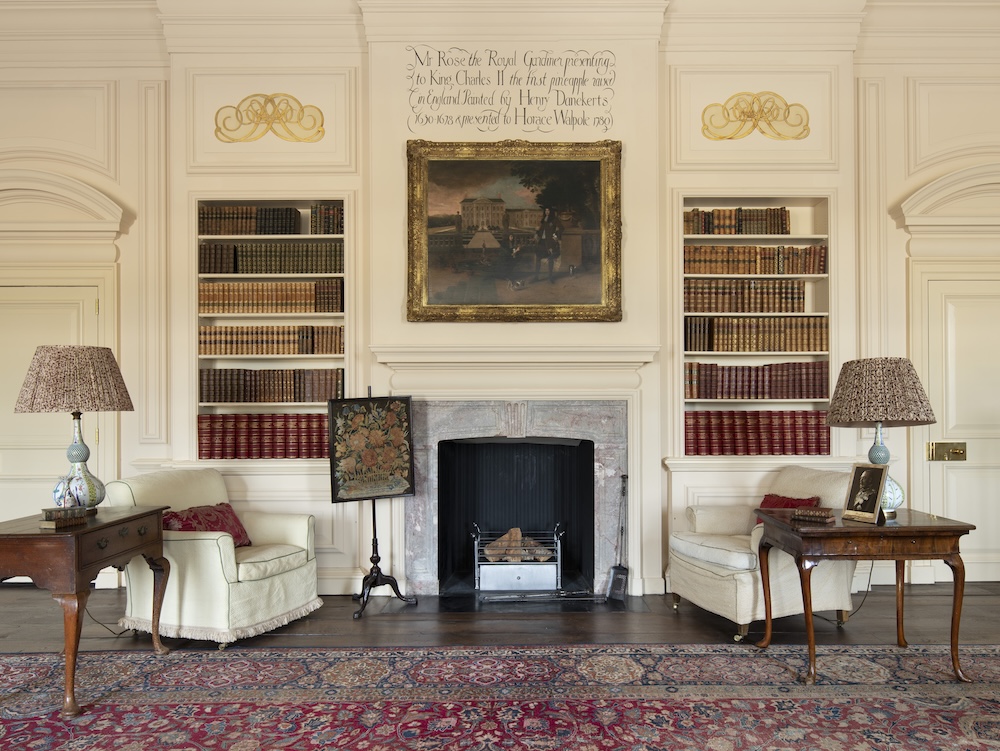 Trent Park House of Secrets, the library with Whistler inscription. Photo Credit: © James O.Davies.
The Trent Park House of Secrets is located at Daffodil Crescent, Enfield EN4 0PS. It is open Tuesday to Sunday from 10-5. Booking is advisable. To get to the Museum, take the Piccadilly line to Oakwood, near where there is a free shuttle bus every 20 minutes from Snakes Lane to Chaplin Drive, close to the museum. If you drive, the car park is a 15-minute walk from the Mansion.


Leave a Reply