



With the news that the Natural History Museum (NHM) has surpassed the British Museum in visitor numbers (seven million as opposed to six million a year) a new focus on the collection of dinosaur fossils and models has started. Many of the dinosaur models were gifts from Andrew Carnegie, who was born in Scotland and never forgot his British roots. They include the model of a Diplodocus (‘Dippy’) which used to be seen as you entered the NHM.
Dinosaurs are once more big business. Jurassic Park is still going strong and the BBC series Walking with Dinosaurs has been joined by Apple TV’s Prehistoric Planet and Netflix’s The Dinosaurs. London is where it began in 1842 when Sir Richard Owen, future founder of the NHM created a new ‘sub-order of Saurian Reptiles’ named Dinosauria (terrible reptiles). This was based on observations he made on shared anatomical features that distinguished the Megalosaurus, Iguanodon and Hyleaosaurus from other land reptiles. For anyone interested in guiding the NHM or any other collection of ancient life, I would like to share how palaeontologists are able to bring these creatures to life and inform their interpretations.
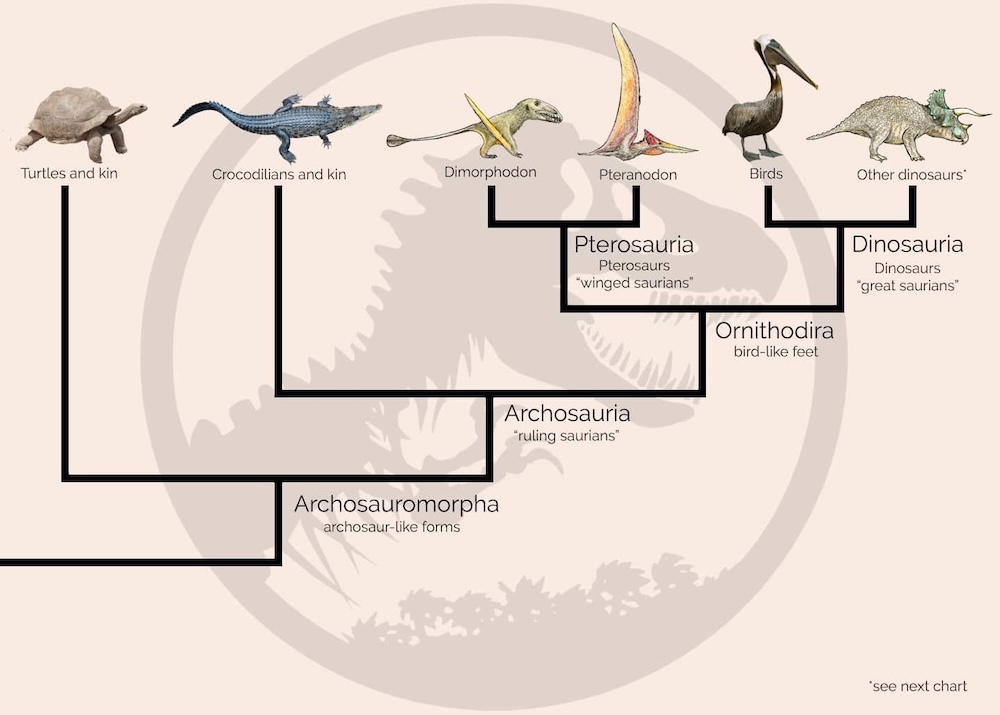 Archosaurs clade descendants crocodiles pterosaurs dinosaurs and birds.
Until the 1980s, dinosaurs were classified like all living organisms using the Linnaean classification system, which allocates species by hierarchies (kingdom, class, order, genus, species) naming them with a binomial system specifying genus and species, i.e., Tyrannosaurus rex. The former has been enhanced and the latter is still in use, but organisms are now studied according to their evolutionary relationships to a common ancestor. In practical terms evolutionary biologists use cladograms to graphically show these relationships. The photograph is a clade, showing how archosaurs are ancestral to crocodiles, pterosaurs, dinosaurs and birds. The three main groups of non-bird dinosaurs are easily recognisable, and can be found at the NHM. They are Theropods, Ornithischians and Sauropods.
The dating of any dinosaur fossil find is given by geological time. Dinosaurs emerged in the Mesozoic Era, which is divided into the Triassic, Jurassic and Cretaceous periods. Dinosaurs became dominant in the Jurassic period. Non-bird dinosaurs became extinct sixty-six million years ago. A Stegosaurus which lived in the Late Jurassic would have never met a T-rex which lived in the Late Cretaceous. The From the Beginning gallery at NHM, shows the chronological sequence of life’s evolution, covering its emergence circa 3.8 billion years ago to the present, including major group radiations such as bacteria, tetrapods, dinosaurs, mammals and multiple mass extinctions throughout Earth’s history.
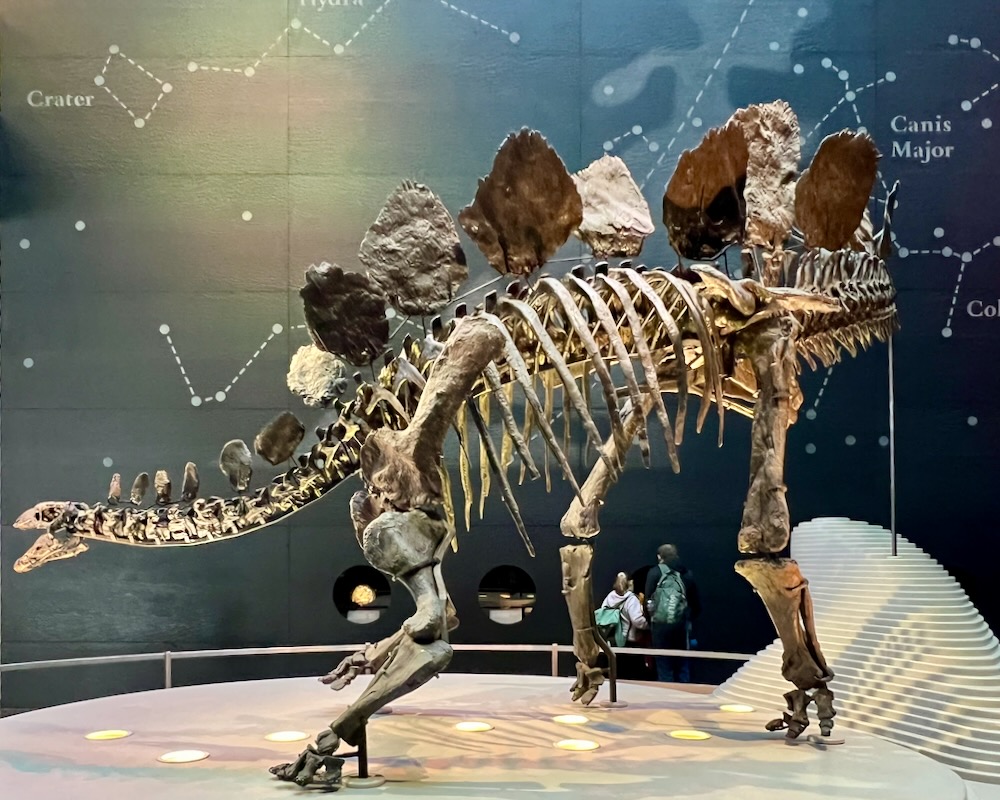 Most intact Stegosaurus fossil at Natural History Museum in London. Photo Credit: © Ursula Petula Barzey.
Dinosaur fossils are the product of mineralisation of bone tissue over a long period of time. After death the specimen would have been quickly buried by sediments. These hard tissues would have then been infiltrated by water and minerals, replacing the actual bones. Sedimentary rocks are not datable, but igneous rocks in adjoining rock layers can be dated with radiometric techniques. The NHM has a rich collection of fossils, such as Sophie the Stegosaurus, but also casts like Dippy the Diplodocus. Bones and teeth are more likely to fossilise, but other structures can be found including skin, scale, feather impressions, filament structures, stomach contents, crests, hooves in duckbill dinosaurs and melanosomes (packets of pigments indicating scale, feather colouration). The NHM’s treasured Archeoropterix lithographica is now believed to have had matte black feathers.
Fundamental to how species evolved their traits is their geographical distribution. The supercontinent Pangea started breaking up in the Triassic, splitting into two land masses – Laurasia (North America, Greenland, Europe and Asia) and Gondwana (South America, Africa, Antarctica, India and Australasia). Today’s continents may show similarities in their fauna and flora, pointing to evolutionary ancestry, but also great diversity, the product of isolation and adaptation to local environments, i.e. marsupial mammals in Australasia verus placental ones everywhere else (there are exceptions). The evolution and distribution of dinosaurs is closely linked to these plate tectonic movements. The NHM has many unique dinosaur fossils found in Britain such as Baryonyx, closely related to the Spinosaurus and the complete Mantellisaurus atherfieldensis displayed in the Hintze Hall.
There are many methods for hypothesising how any species behaved. Its morphology, anatomy and dentition may indicate feeding habits, diet, competition and more. A host of advanced technical applications, such as CT scanning and computer modelling, are at hand to calculate body mass, locomotive speed, bite strength, how strong were their senses for smell, sight and others. Notice the pockmarked depressions in a T-rex jaw, where powerful muscles attached to drive its bone crushing bite.
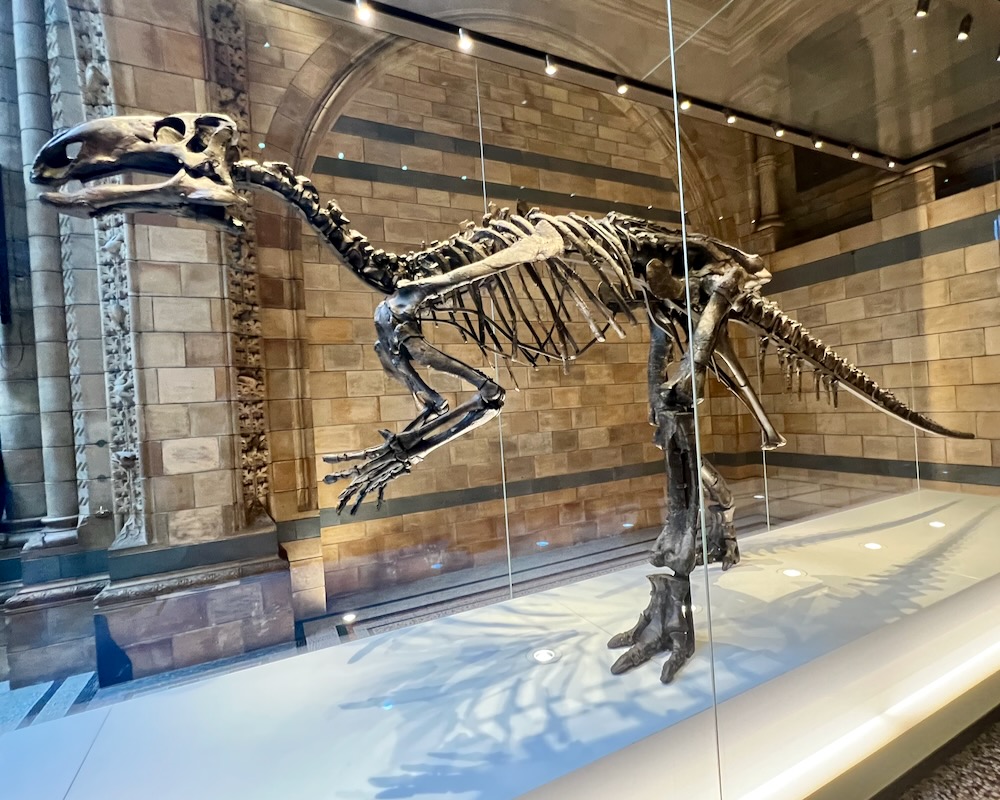 Dinosaur, Mantellisaurus atherfieldensis at Natural History Museum in London. Photo Credit: © Ursula Petula Barzey.
Trace fossils are just as valuable and include tracks, footprints, eggs and poop (coprolites). Some T-Rex droppings will not just buy you a holiday, but also reveal the animal’s last meal. We can thank Mary Anning for first finding coprolites and Westminster Abbey’s William Buckland for naming them. Arguably, the Iguanodon is not the most charismatic of dinosaurs, but its discovery and subsequent interpretation is a fascinating journey in the development of palaeontology.
The Iguanodon was one of the three original species used by Sir Richard Owen in 1842 to create a new clade of reptiles termed Dinosauria. In 1822, pioneering palaeontologist Gideon Mantell and his wife discovered in a dump pit in Cuckfield Sussex, a set of teeth that looked like those of an iguana, albeit much larger. In 1834 Mantell got hold of the Maidstone slab, known as the Mantell-piece (Dinosaur Gallery). It shows some disarticulated bones including fragments of the skull, pelvis, feet, limbs, vertebrae and ribs. To the untrained eye, it’s hard to visualise what this creature looked like, but by then, Mantell’s descriptions and depictions showed a bulky iguana-like quadrupedal reptile covered in scales. Maidstone Borough Council features a green rampant Iguanodon in their coat of arms, how awesome!
Years later, with the creation of the Crystal Palace Geological Park, it was Owen who acted as a consultant behind Benjamin Hawkins Waterhouse’s concrete sculptures of ancient beasts. Inevitably, it was Mantell’s interpretation, which Hawkins followed, placing the spiky thumb on the creature’s snout, like a modern-day rhinoceros. At the NHM, a model of the sculpture can be seen alongside a model of the Megalosaurus.
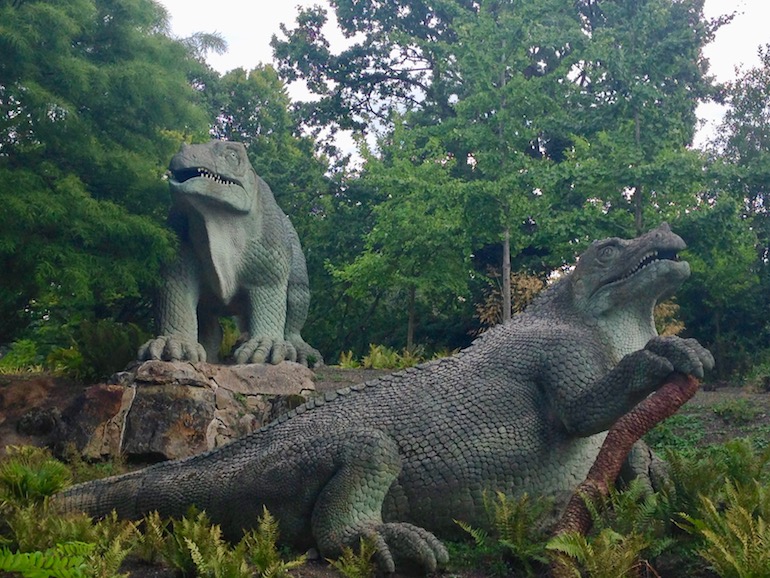 An 1853 model of an Iguanodon; the most recognisable of the Crystal Palace Dinosaurs in London. Photo Credit: © Ursula Petula Barzey.
The Crystal Palace sculptures are much derided nowadays for their inaccuracy, but back in 1854 they were the very first ever life-size tridimensional depictions of ancient creatures. Their depictions were informed by pioneering palaeontologists with very limited fossil material, which forced them to rely on comparative anatomy to fill the gaps. It was also a novel entrepreneurial venture aimed at creating an educational leisure park, which included an enhanced Crystal Palace structure, with galleries reimagining ancient Greece and Egypt and an events venue. The famous engineer Isambard Kingdom Brunel worked on the lake’s impressive set of fountains, which operated in tandem with a tidal water system surrounding the sculptures, hiding and revealing at low tide Mary Anning’s Ichthyosaurus. Nearby a pair of Iguanodons, a Hylaeosaurus and a Megalosaurus bask in the sun. Owen’s contribution to the project, was a dinner he organised on New Year’s Eve 1853 which took place inside the incomplete Iguanodon sculpture in Hawkins’ workshop. The event was reported in the London News, with a charming illustration of many gentlemen seated inside the beast under the names of Buckland, Cuvier, Owen and Mantell, the four leading palaeontologists of the age.
In 1878, 38 mostly fully articulated Iguanodon skeletons where discovered in a mine in Bernissart in Belgium, a combination of adults and young – it seems parents took care of their offspring. Our two casts are exact copies of the original mounted specimen still on display in Belgium. This Iguanodon interpretation is now obsolete. For a long time there was a perception, that the Iguanodon and other dinosaurs, including T-rex dragged their tails, suggesting they were slow moving and lethargic. No track fossils suggesting this has ever been found in rock formations with dinosaur fossils.
Both theropods and ornithischians are believed to have been warm-blooded, in lieu of their very active lifestyle. Today’s Iguanodon’s interpretation shows them as being bipedal but able to walk or run on all four, horizontally postured with their necks parallel to the ground and a counterbalancing tail in the air, held in place by powerful muscles, (just like the Mantellisaurus atherfieldensis in the Hintze Hall – also an iguanodontid). A recent find in China of a Haolong dongi, a close relation, shows that somewhere covered with polygonal scales interspersed by spiky filaments. The Iguanodon may not be as glamorous as a T-rex, but can still tell a good story that keeps being revised.



Leave a Reply