



The ancient DNA project connected to Winchester Cathedral is one of those rare historical investigations that feels almost unreal when you first hear about it. Hidden high above the cathedral chancel are a series of painted wooden mortuary chests which are believed to contain the bones of some of the most important people from Anglo-Saxon England. For centuries, people accepted the labels on the chests at face value. They were said to contain kings, bishops, and a queen from the old kingdom of Wessex, including figures linked to Alfred the Great’s family and even King Canute.
What nobody really knew, however, was whether the bones inside actually belonged to the people named on the chests. That uncertainty contributed to questions the ancient DNA project was set up to answer.
The story really begins long before the scientific work started. Winchester itself was once the centre of royal power in England. Before London became dominant, Winchester was effectively the capital of Anglo-Saxon England. Kings ruled from there, important religious ceremonies took place there, and many members of the royal family were buried there. When the Norman cathedral was built in the eleventh century, the coffins from the Anglo-Saxon cathedral — known as the Old Minster — were carried over to the ‘new’ cathedral and set around the presbytery. Fifteenth century remodelling saw the removal of the chests and the gathering of their contents into new decorative chests which were later displayed high up on screens surrounding the high altar.
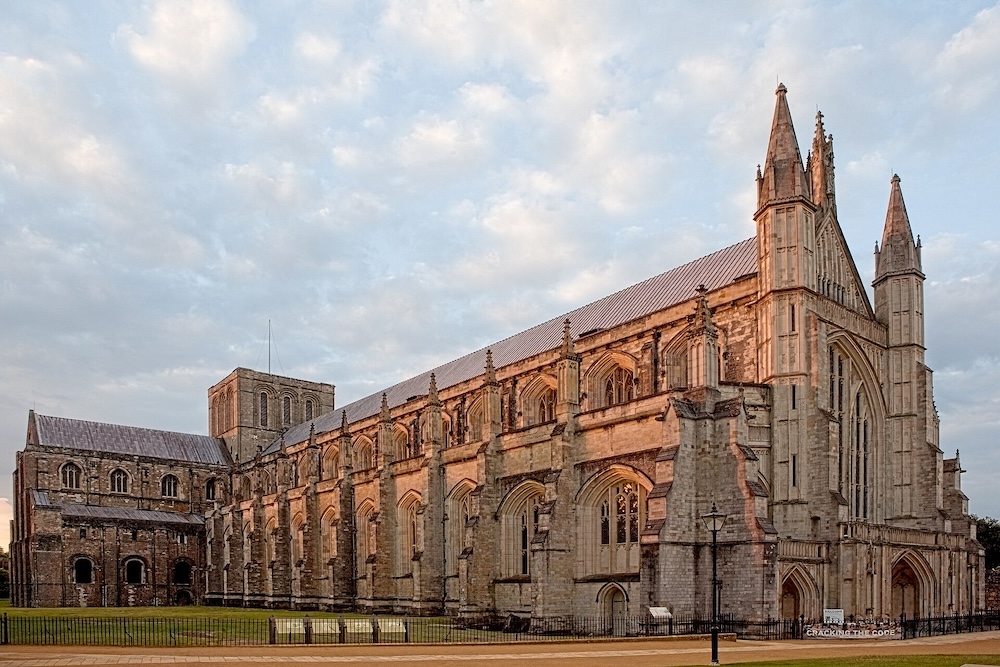 4am shot of Winchester Cathedral showing west end, central tower & UKs 2nd longest cathedral nave. Photo Credit: © WyrdLight.com via Wikimedia Commons.
Today, Winchester still feels deeply connected to its history. One of the nicest things about the city is how accessible it is. It is only about an hour from London by train, which makes it an easy day trip, although many visitors end up wishing they had stayed longer. Visitors wanting a deeper understanding of the city’s Anglo-Saxon and medieval past often choose to explore with a Blue Badge Tourist Guide, whose specialist knowledge can help bring Winchester’s royal history and cathedral heritage to life. Winchester has a quieter atmosphere than London, but there is history everywhere you look. You can spend the morning exploring the Great Hall with its famous medieval Round Table linked to the legends of King Arthur, then walk beside the clear waters of the River Itchen, which winds gently through the city and nearby water meadows. Winchester College, founded in 1382, is another reminder that the city has been a centre of learning and culture for centuries.
The cathedral itself is extraordinary even without the mortuary chests. It is one of the largest Gothic cathedrals in Europe, and it also contains the grave of Jane Austen, whose burial there surprises many visitors. Her modest grave lies in the north nave aisle, although later memorials and stained-glass windows acknowledge the importance she would eventually have in English literature.
Unfortunately, the bones in the mortuary chests did not remain untouched. During the English Civil War in 1642, Parliamentary soldiers reportedly broke open the chests and scattered many of the remains around the building. Later, the bones were collected and returned to the chests, but by then everything had become mixed together. Over the centuries the contents turned into a confusing collection of skulls, ribs, femurs, and fragments from multiple individuals.
For a long time, nobody could do much about it. Historians could speculate, but there was no real way to separate one skeleton from another. Modern science changed that.
Around 2012, Winchester Cathedral began a major conservation project involving the mortuary chests. Researchers from the Universities of Winchester, Bristol and Oxford, and the Francis Crick Institute became involved. When the chests were carefully opened, the scale of the problem became obvious almost immediately. Instead of complete skeletons neatly assigned to named kings, researchers found more than a thousand individual bones belonging to at least twenty-five different people.
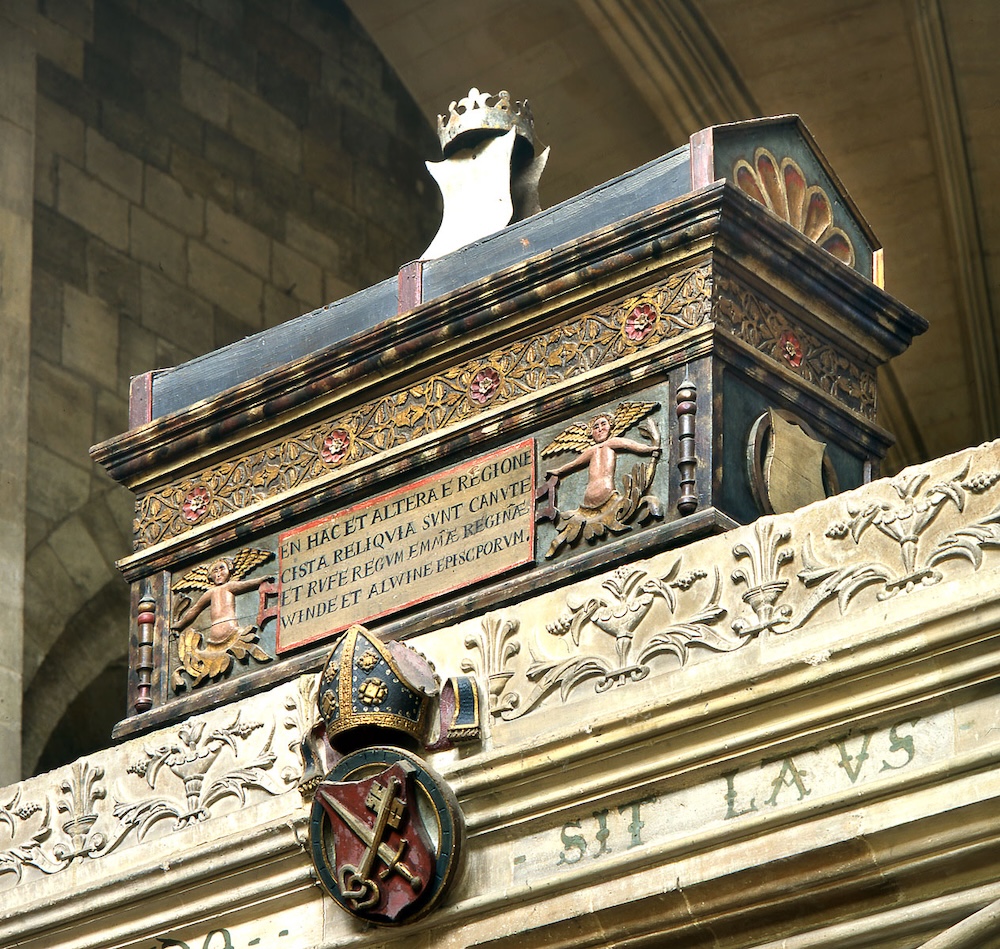 One of Winchester Cathedral’s famous mortuary chests, traditionally believed to contain the remains of King Canute and Queen Emma of Normandy. Photo Credit: © Winchester Cathedral.
What makes the project fascinating is the combination of hard science and historical detective work. Researchers were not simply trying to identify bones. They were trying to reconstruct an entire lost royal world from fragments.
Ancient DNA analysis became one of the most important tools in the investigation. Extracting DNA from bones that are over a thousand years old is extremely difficult because genetic material degrades naturally over time. In addition, these remains had been handled repeatedly over the centuries, increasing the risk of contamination. Scientists focused on the densest parts of the skeleton, especially sections of the skull and teeth where traces of DNA survive best.
At the same time, osteologists studied the bones themselves. By examining things like arthritis, injuries, bone size, and tooth wear, they could estimate age, sex, health, and even aspects of lifestyle.
One of the more interesting discoveries is that the traditional labels on the mortuary chests are probably far too simple. There are clearly more people in the chests than the names painted on the outside. Researchers also discovered the remains of children and younger individuals who were never mentioned historically. This suggests that the story of the chests is more complicated than earlier generations realised.
There has been particular interest in Queen Emma of Normandy. Emma was an incredibly important figure in English history because she married both Æthelred the Unready and King Canute, linking two royal dynasties together. Since only one mature female skeleton has been identified among the remains so far, some researchers suspect they may actually have located Emma herself, although no final confirmation has been made.
The possibility of identifying family relationships through DNA is perhaps the most exciting aspect of the whole project. If enough genetic material survives, scientists may eventually be able to confirm direct links between known royal figures. Historians already know, for example, that Egbert and Æthelwulf were father and son. DNA evidence could potentially confirm those relationships scientifically for the first time.
What I find especially interesting is how the project changes the way we think about medieval history. These are no longer just names in a textbook or figures in stained glass windows. The bones reveal details about real people — how tall they were, what diseases they suffered from, whether they had physically demanding lives, even what kind of food they regularly ate.
In 2026 many of the remains were reinterred inside the cathedral after years of study. The cathedral has reportedly placed a long-term restriction on reopening the chests.
That naturally raises the question of what might be discovered in 2060 or beyond.
If ancient DNA science develops at the speed it has over the last twenty years, future researchers may be able to do things that seem impossible today. At the moment, scientists are often working with damaged fragments of DNA. In the future they may be able to reconstruct complete genomes from tiny surviving traces. That could allow much more confident identification of individual kings and queens.
Future analysis might also reveal physical characteristics such as eye colour, ancestry, inherited diseases, and precise family connections.
At the same time, some mysteries may never be solved completely. Ancient history is rarely neat or perfect. Bones decay, records disappear, and evidence gets mixed together. Part of the fascination of the Winchester project comes from that uncertainty.
What Winchester’s Mortuary Chest project has already achieved, though, is remarkable. It has transformed the mortuary chests from symbolic relics into one of the most important scientific and historical collections in England. More importantly, it has brought a human dimension back to people who lived over a thousand years ago. Instead of distant legendary rulers, they become individuals again — people with families, illnesses, diets, and lives that can still be traced through fragments of bone preserved inside Winchester Cathedral.


Leave a Reply