



The seventy-metre-long Bayeux Tapestry has recently left the museum it has been housed in for the first time to come to a special exhibition at the British Museum. The museum where it is held is closed and undergoing a revamp that will cost twenty million euros when it is finished. The Bayeux Museum is due to reopen in October 2027.
There was considerable opposition to relocating the Bayeux Tapestry. The late artist David Hockney said it was ‘madness’ to move it and warned that the linen background was in danger from the move. In the end, the tapestry was delivered safely to the British Museum in the middle of the night and has just opened to the public in Britain to rave reviews.
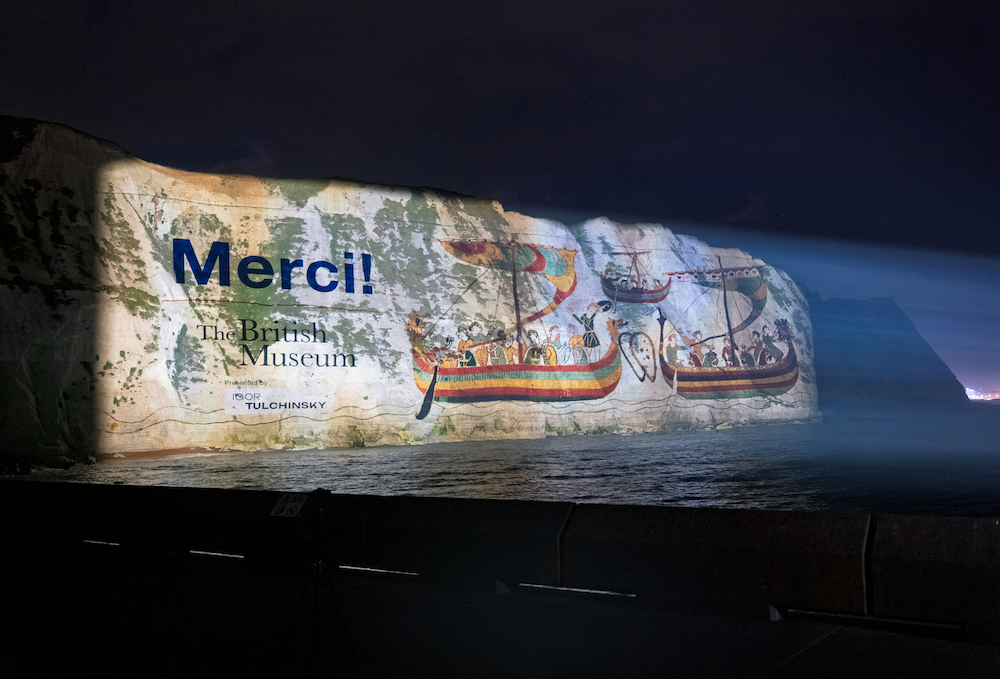 Bayeux Tapestry Cliffs of Dover thank you. Photo Credit: © The Trustees of the British Museum.
The English were badly affected by the defeat of King Harold by the man universally known today as ‘William the Conqueror’, although he was known as ‘William the Bastard’ in his day, This has nothing to do with his attitude to the Saxons he conquered but to the fact that he was the illegitimate son of Robert, Duke of Normandy. Although settled in France, the Normans had a warlike strain and their name stands for ‘Norsemen’, indicating that they had Scandinavian and, therefore, Viking origins.
William was eventually victorious at the Battle of Hastings in October 1066, the last time England has been conquered by force of arms. King Phillip of Spain, Napoleon of France and Hitler of Nazi Germany all tried – and failed – to conquer the country, which has remained undefeated since 1066. This is the most famous date in English history and is engraved on the minds of all schoolchildren.
 Nicholas Cullinan & Hélène Tréheux-Duchêne at the British Museum Photo Credit: © Trustees of the British Museum.
Bayeux Tapestry Cliffs of Dover thank you. Photo Credit: © The Trustees of the British Museum.
The Bayeux Tapestry tells the story of William the Conqueror’s triumph at Hastings on the south coast of England and events leading up to the battle. Edward the Confessor, the childless king who died in 1065 and who built the original Westminster Abbey, had promised the crown to William, but Harold, who was Edward’s brother-in-law, refused to recognise the Norman king, and the two men fought at Hastings for the crown of England. William brought an army of up to 10,000 men to the battle, where he confronted a smaller Saxon army of around 8,000 men on 10 October, which was commanded by Harold, whose men had just defeated a Viking army at Stamford Bridge in Yorkshire. The army they fought there included Tostig, Harold’s brother, and was commanded by Harald Hardrada, a Viking leader. Were King Harold’s men exhausted by the long march to Hastings? Probably. In any case, the English army was defeated by the Normans, and Harold died when he was hit by an arrow in the eye – according to legend and the tapestry. Although he was the first king to be crowned at Westminster Abbey, Harold was King of England for barely a year and has no known grave.
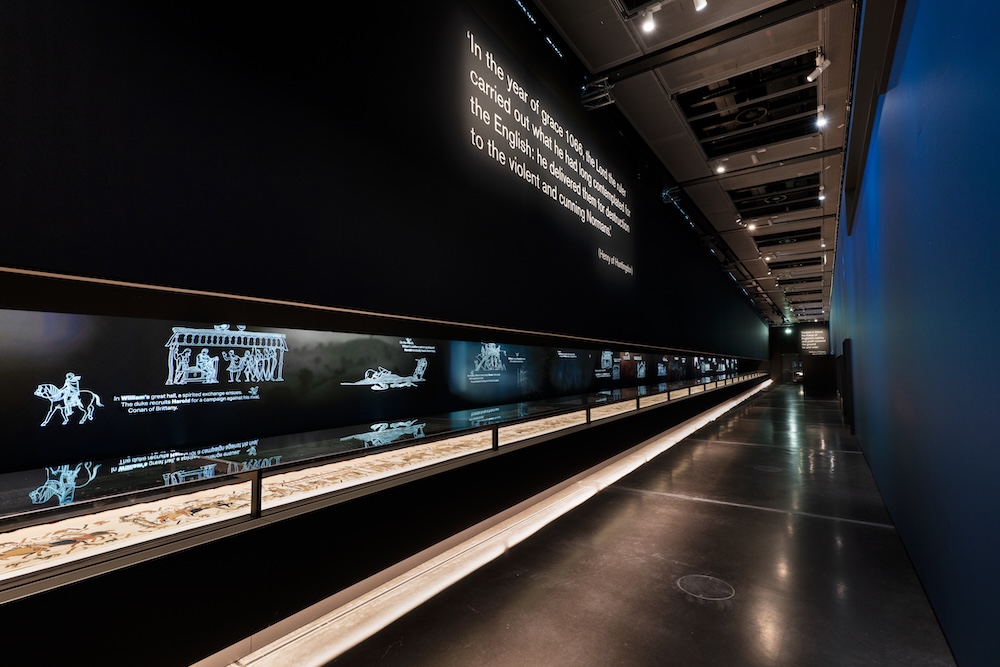 Bayeux Tapestry Exhibition. Photo Credit: © The Trustees of the British Museum.
So William was victorious at the battle which was fought seven miles north of Hastings near the town of Battle. French became the language of the court for several centuries and it was not until the time of Geoffrey Chaucer who is known as ‘the father of English poetry’ that a new language developed and eventually spread around the world. This was modern English and, although Chaucer’s language can be difficult to follow for the modern reader, it is recognisably English.
The Bayeux ‘Tapestry’ is really an embroidery and is seventy metres (230 feet) long and fifty centimetres (twenty inches) high. It consists of fifty-eight scenes and its survival has been described as ‘miraculous’. It was probably constructed in England as a gift for William. The entrance fee to the exhibition at the British Museum costs £33 and tickets have sold out for the whole of 2026.
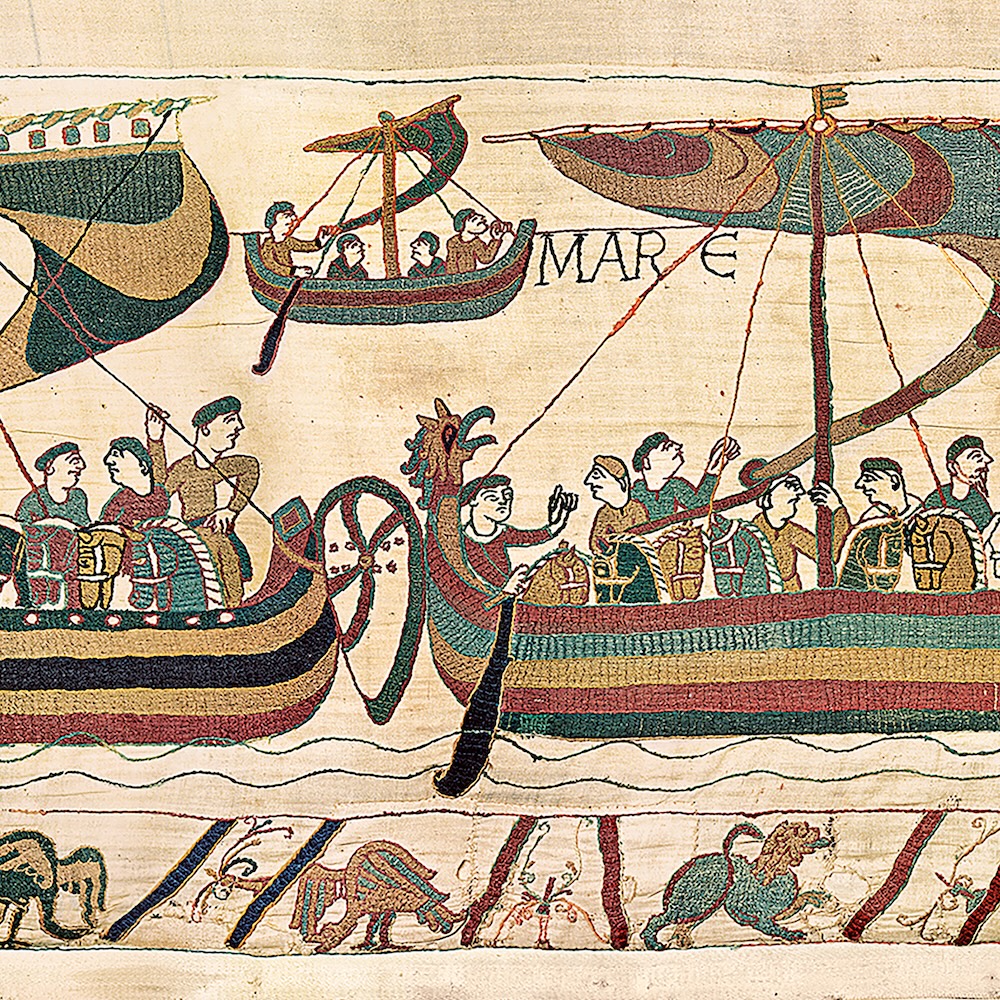 Bayeux Bayeux Tapestry at the British Museum in London. Photo Credit: © LFPN A. Cazin.
The Bayeux Tapestry at the British Museum
The Bayeux Tapestry is on display at the British Museum until 11 July 2027, marking the first time it has been shown in Britain for almost 1,000 years. Entry to the exhibition is by timed ticket, and advance booking is essential due to exceptionally high demand. Visit the British Museum website for current ticket availability, prices, opening hours and the latest visitor information. Please note that photography of the Bayeux Tapestry is not permitted.
Explore More with a Blue Badge Guide
Combine your visit to the Bayeux Tapestry with a British Museum Tour led by one of our qualified London Blue Badge Tourist Guides. Your guide can introduce some of the museum’s most important objects and help bring the wider world of 1066 to life—from the Vikings and Anglo-Saxons to medieval Europe and the legacy of the Norman Conquest. It is an ideal way to make more of your day at the museum.




Leave a Reply