
Tina Engstrom

Dutch Artists In The Age of Vermeer Exhibition at The Queen’s Gallery

Launching on 13th November 2015 at The Queen’s Gallery, Buckingham Palace is a new exhibition titled: Masters of the Everyday: Dutch Artists in the Age of Vermeer.

The Dutch artists of the 17th century painted ordinary people doing everyday things. They offer us a glimpse into the rumbustious life of village taverns and peasant cottages, and the quiet domesticity of courtyards and parlours. While the subject matter may be ordinary – the preparation of food, eating and drinking, the enjoyment of music or a family game – the painting is rich and jewel-like, with equal attention paid to a discarded clay pipe as to a fine silk drape. The meticulously documented details often allude to a work’s deeper meaning or to moral messages that would have been familiar to the contemporary viewer.

Presenting 27 masterpieces from the Royal Collection, the exhibition includes works by Gerrit Dou, Gabriel Metsu, Jan Steen and Pieter de Hooch, and Johannes Vermeer’s A Lady at the Virginal with a Gentleman, ‘The Music Lesson’.  The Masters of the Everyday: Dutch Artists in the Age of Vermeer exhibition is on from 13 November 2015 to 14 February 2016 at The Queen’s Gallery.  
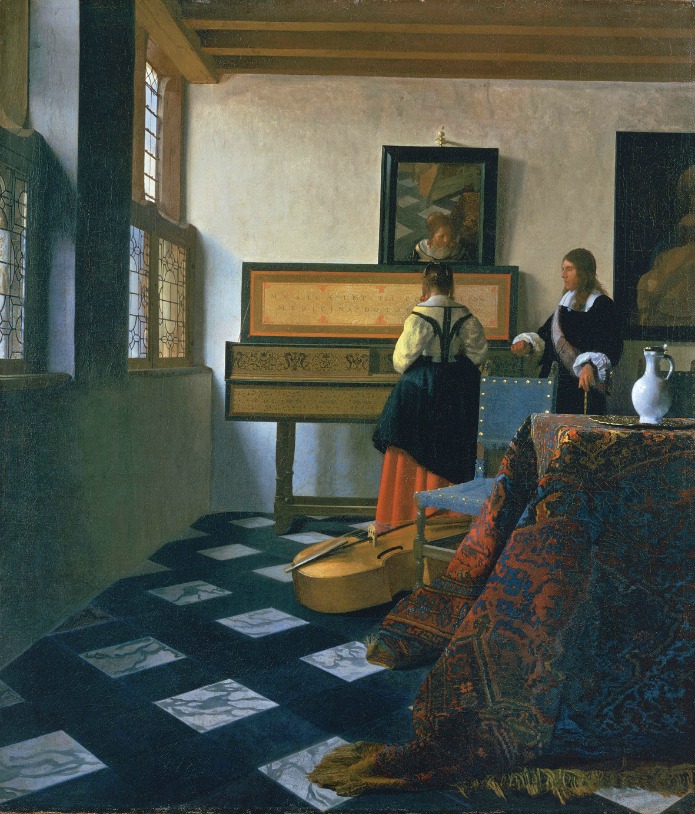
Lady at the Virginals with a Gentleman or The Music Lesson

Lady at the Virginals with a Gentleman or The Music Lesson, 1662-5. Photo: © Royal Collection Trust, Her Majesty Queen Elizabeth II 2015.

 

Leave a Reply

Your email address will not be published. Required fields are marked *

You may also like

Claude Monet Exhibition at the Courtauld Gallery in London

London has been a smokeless zone for over sixty years. The city used to be famous for its ‘London fogs.’ They were described by the novelist Charles Dickens and even led to the creation of a type of American rainwear called London Fog. Then the Clean Air Acts were passed in the late 1950s and 1960s, largely as a reaction to the ‘great smog’ of 1952 and London Fogs gradually became a thing of the past that will hopefully never be seen again.

Read more

Three Ships In London To Visit

London is a port city, and Britain became great because of its navy and ability to trade across the globe. The capital’s wealth is built upon that sea trade. There are reminders of London's maritime history everywhere. In Trafalgar Square, we commemorate the 1805 victory (and the death) of Admiral Lord Nelson at the Battle of Trafalgar. At Tower Hill, we remember the 36,000 merchant mariners lost at sea with no known grave. And the Museum of London Docklands examines the triangular trade in goods, sugar and slaves, upon which so much of the city’s wealth was built.

Read more