



There are over 400 sculptures scattered across London with several in the Bishopsgate and Liverpool Street area. My favourite is a gigantic sculpture outside the Broadgate exit of Liverpool Street station called “Fulcrum” by the American sculptor Richard Serra. I am absolutely taken by it not only because of its size, and at 55 ft or 16.7m height it is sizeable enough, but because of its simplicity and elegance.
Richard Serra as a sculptor is known for his large-scale art and its use to engage with the viewers and the surroundings. This engagement is not always successful; in 2005, an Art Centre in Madrid announced that a 38-tonne sculpture of his had been “mislaid”!
With “Fulcrum” he is creating what is know as “site-specific art”, meaning that he uses the site’s limitations to the benefit of the sculpture. The whole of the Bishopsgate development is built on the air space above the railway station lines. In these specific very urban surroundings, his artwork thrusts upwards in a way very much like gothic cathedrals do. The space created asks viewer to enter and seek sanctuary, again very much like cathedrals do. It’s great fun seeing children play hide-and-seek with the sculpture.
The sculpture is very rusty, it almost looks like it should be taken away for scrap. Actually it is made of a special type of steel which weathers but does not decay. Richard Serra is very particular about the use of metal and is very knowledgeable about it too. He worked in steel mills as a way of financing his English Literature studies.
According to the ideas of “site-specific art” the sculpture fits in with its surroundings not only geographically but on an intellectual level too. As a literature graduate, to name his sculpture “Fulcrum” – balance – and to place it outside one of the busiest stations in the City, the financial district with its macho and the sky is the limit culture, must have made him chuckle. It makes me chuckle every time I see it.
So the next time you are in the Liverpool Street area of London, do take the time to see it or even better why not make a special journey. It is a great work of art and is admissions free, how often do you find that in London!
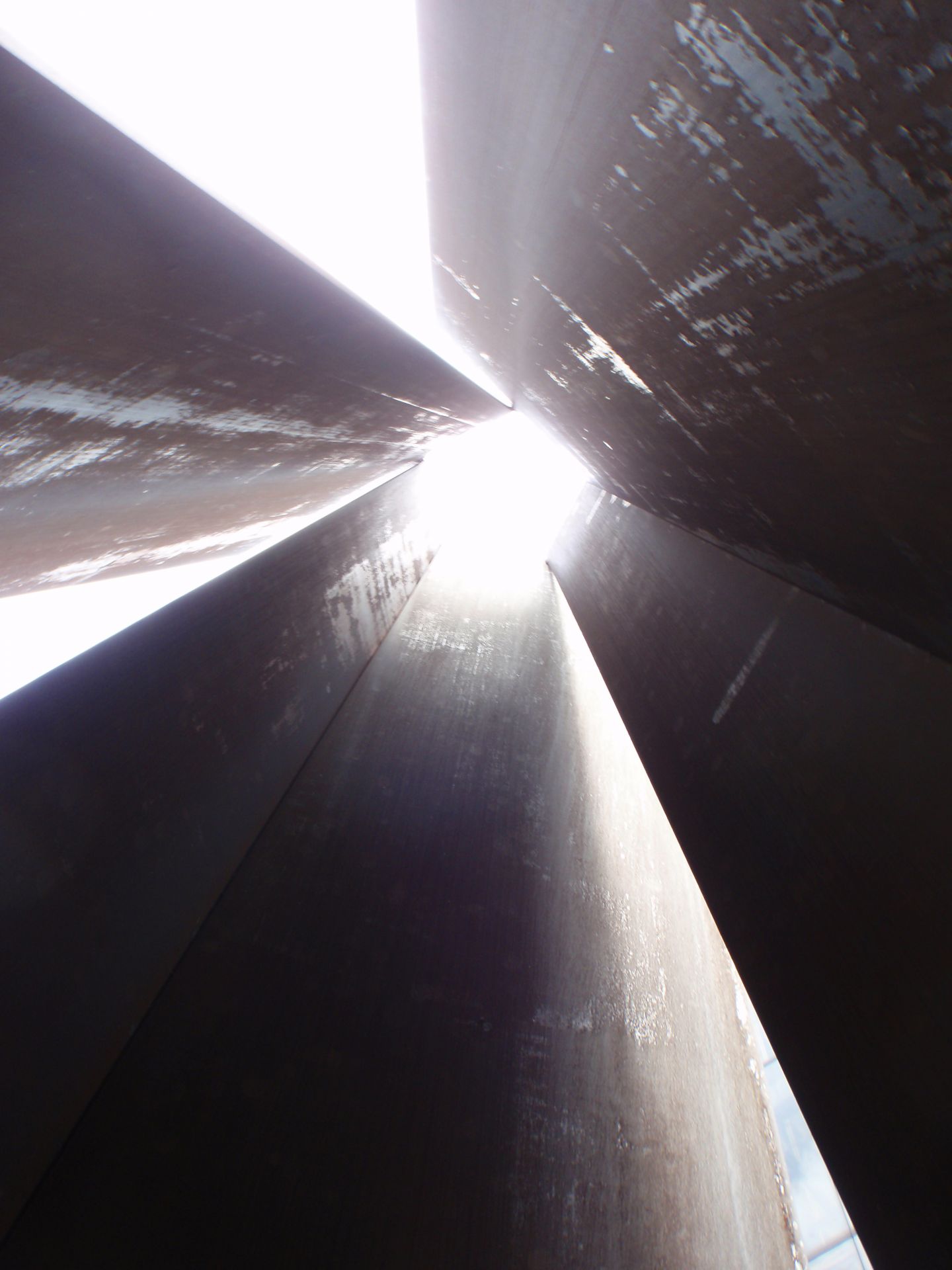
Fulcrum by Richard Serra. Photo: ©Themis Halvantzi-Stringer.
END
Would you like to explore London and beyond with a highly qualified and enthusiastic Blue Badge Tourist Guide? Use our Guide Match service to find the perfect one for you!


Is this plagiarised? Or do you happen to also be the owner of the post from this link (https://guidesoflondon.wordpress.com/2010/06/01/fulcrum/)?