



The National Health Service (NHS) was founded in 1948 by the Labour government under Clement Attlee, who came to power after the Second World War, succeeding Winston Churchill’s wartime coalition. This was before the days of opinion polls, and many people were (and are) surprised by the scale of Churchill’s defeat, although he returned to govern the country in 1951. The NHS was the brainchild of a fiery Welshman called Nye Bevan, who should not be confused with Ernie Bevin, the Foreign Secretary in Attlee’s government.
London has more than 20 hospitals that serve its population of over 9 million people. Most of these are run by the NHS, but a few are private hospitals, often run by the British United Provident Association, a private health provider, which usually, like the NHS, goes by its initials. BUPA was founded in 1947 and provides competition for the NHS, and some companies offer private health for their employees as a perk to attract applicants. Most people are happy enough, however, to rely on the NHS for healthcare provision.
Life expectancy is longer than when the NHS was founded. It is seventy-nine, as opposed to sixty-six, for men and eighty-three, as opposed to seventy-two, for women. In addition, medical advances have been significant since 1948, so the NHS is struggling to keep up with advances in people’s expectations. However, the principle of free health care for all at the point of service still applies. Overseas visitors get free Accident and Emergency health care, but those who want the non-urgent attention of a doctor are expected to pay for it.
London’s most famous hospitals are:
Saint Thomas’ Hospital stands across the river from the Houses of Parliament. It has a new building but is actually an old hospital, founded around 1100. It was originally named after Saint Thomas à Beckett, but Henry VIII, not wishing to draw attention to someone who defied royal authority, had it renamed in honour of Saint Thomas the Apostle. Most visitors, however, associate it with Beckett and it stands by Lambeth Palace, the London home of the Archbishop of Canterbury, an office held by him, and which led to a dispute with his king, Henry the Second, over the issue of sanctuary in the late 1100s.
Tommy’s, as it is known in the medical profession, was where Florence Nightingale founded the nursing profession after her work in the Crimean War. She was known as ‘the lady with the lamp’, as she tended to the wounded soldiers. She always said that hospitals should be open and well-aired and she did a great deal to reduce soldiers’ deaths from wounds.
St Thomas’ Hospital has a statue of another nurse, Mary Seacole, as well as a museum dedicated to Florence Nightingale. Seacole’s statue stands by the River Thames looking over to Parliament. Although she was largely forgotten after her death, she was later voted the Greatest Black Briton in a poll and was posthumously awarded the Jamaican Order of Merit in 1990. Like Nightingale, she nursed the soldiers who were wounded in the Crimea but she was more of an entrepreneur and expected to make money from her nursing work.
The hospital has 840 beds and a busy Accident and Emergency Department. Ambulances can often be seen coming into or out of the hospital as coaches approach Westminster Bridge.
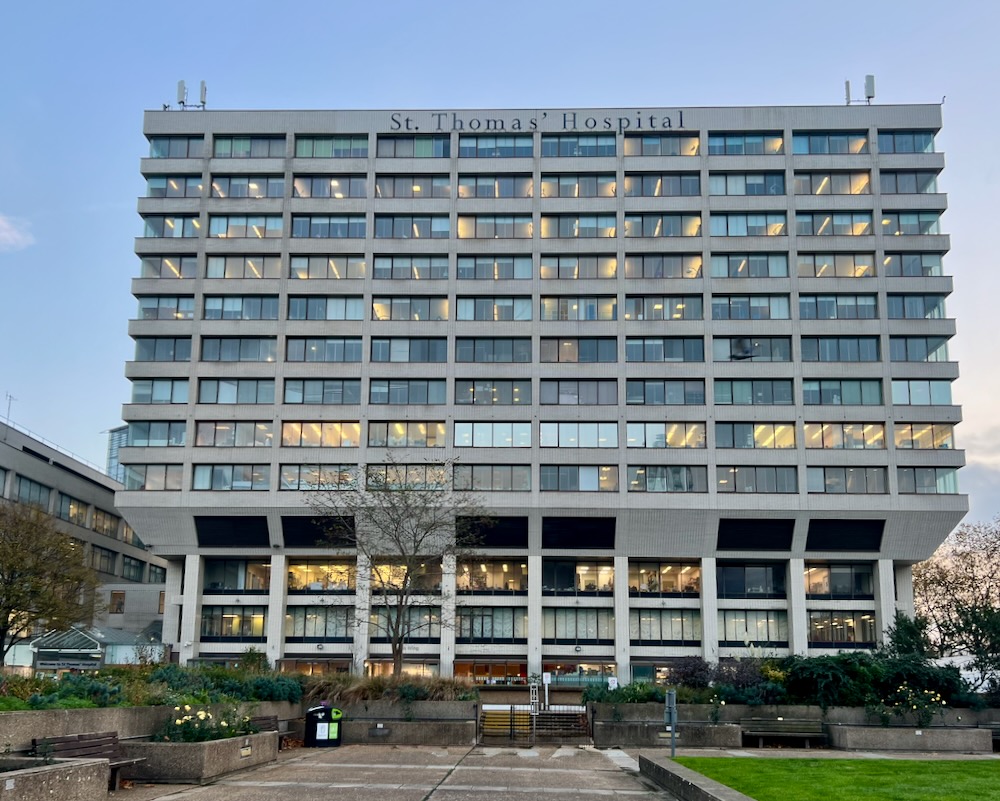 St Thomas Hospital in London. Photo Credit: © Ursula Petula Barzey.
St Bartholomew’s Hospital has a claim to be older than St Thomas’ and was founded in 1123 by Rahere, a twelfth century priest who also founded Saint Bartholomew’s Priory church nearby. Barts, as it is usually called, is no longer an Accident and Emergency Hospital as the population it serves nearby is quite small, but it plays an important role in teaching medicine and specialises in cardiac (heart) care and cancer. Barts has 387 beds.
After the dissolution of the monasteries, which was ordered in the early 1500s by King Henry VIII, the hospital was under threat but the king, anxious not to be seen as a closer of hospitals, re-founded it. His statue can be seen at the hospital’s entrance in Smithfield.
It was at St Bartholomew’s that the fictional characters Sherlock Holmes and Doctor John Watson first met, as detailed in Sir Arthur Conan Doyle’s first Holmes story A Study in Scarlet. Doyle trained as a doctor and passed the time while he waited for patients by composing detective stories. They are narrated by Watson, who trained at Bart’s, and were a huge success leading Doyle to give up medicine for literature. He was reportedly inspired to create Holmes by the example of his tutor Joseph Bell who, like Holmes, had a good eye for detail.
Guy’s Hospital was founded by Thomas Guy in 1721. It was where the London-born poet John Keats was trained as a doctor. He did not practice as one but knew enough to be able to analyse the blood that he coughed up and identified as ‘arterial’, thus confirming that he would soon die of tuberculosis, which was then known as consumption. Keats’ statue was unveiled in 2007 by Andrew Motion, who wrote a biography of his fellow poet. It stands in an alcove of the old London Bridge at the hospital near London Bridge station and the Shard.
The hospital has 400 beds, although Accident and Emergency services are now outsourced to Saint Thomas’s Hospital, which also stands south of the River Thames. At nearly 500 feet high, the Tower Wing at Guy’s was once the tallest hospital building in the world, although it has now been surpassed by a building in Houston and is dwarfed by the 1000-foot Shard.
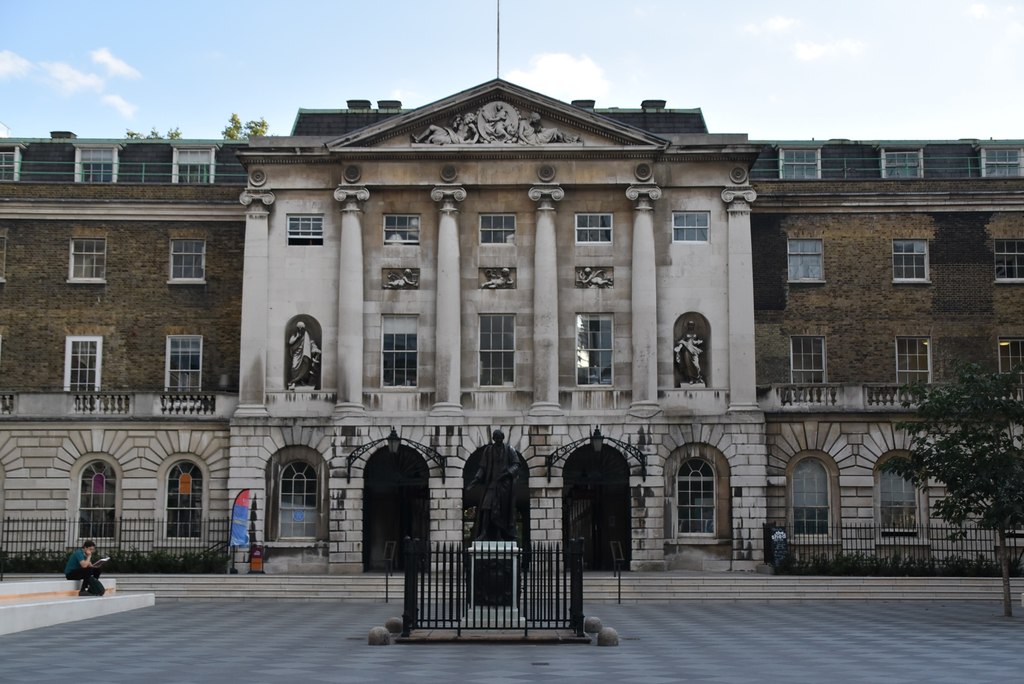 Guy’s Hospital in London. Photo Credit: © N Chadwick via Wikimedia Commons.
The Cromwell Hospital on the Cromwell Road in South Kensington is probably the one most often seen by visitors to this country because it is on the route into the capital from Heathrow Airport and stands near to many of the hotels used by groups in London. It is unusual in that it is a private hospital which is run by BUPA rather than the NHS, like most of the others in London. It was founded in 1981 and has 120 beds. Among its patients was famous footballer George Best, who died there in 2005 after a long battle with alcohol.
The Great Ormond Street Hospital is also unusual in that it was built for and still serves mainly children. It is an NHS hospital and was founded in 1852 as a hospital for children by Doctor Charles West. Amongst its supporters and benefactors were Queen Victoria, Charles Dickens, and the storyteller James Barrie, who gave it the copyright to his play Peter Pan. It also worked with the author Roald Dahl in developing a valve for children’s hearts. Dahl’s own son was struck by a taxi in New York and suffered from heart problems for years. The machinery that he helped develop has been successfully used on over 3,000 children.
Despite controversies and lawsuits, the hospital continues to care for children. It is in the London Borough of Camden, is often known by its initials GOSH, and has nearly 400 beds.
Moorfields Eye Hospital is another specialist hospital that specialises in ophthalmology, the science of treating eye infections. It was founded in 1805 and is based in Clerkenwell, near the City of London, although it is due to move to the King’s Cross area in 2027 with the name of Oriel. It is in City Road, near where it has been based for over 200 years. Moorfields has an international reputation and has trained eye specialist doctors from Britain and around the world, from Singapore to Pakistan, Australia to New Zealand.
The Middlesex Hospital no longer exists, as hospital provision in the capital was rationalised, and it was closed in 2005 to merge with another hospital. The Middlesex was based in the Fitzrovia area, and it was there that the actor Peter Sellers died of a heart attack in 1980 at the age of fifty-four. It pioneered treatment of the AIDS infection, and Diana, Princess of Wales, visited the hospital in 1987, shaking the hands of patients without wearing any gloves.
The Charing Cross Hospital was originally sited near Trafalgar Square but moved five miles to Hammersmith in 1973 and was opened by the late Queen at the site of the Fulham Hospital. However, it retained its name, which has led to some confusion. The original Charing Cross Hospital was opened in 1818. The modern one has over 500 beds and an A & E department.
The hospital has a teaching wing and trained doctors such as Darwin’s supporter Aldous Huxley and David Livingstone, who was mainly famous as an explorer in Africa. The journalist Henry Morton Stanley, who had been sent to find Livingstone, was careful to address him properly and introduced himself with the famous greeting: ‘Doctor Livingstone, I presume?’
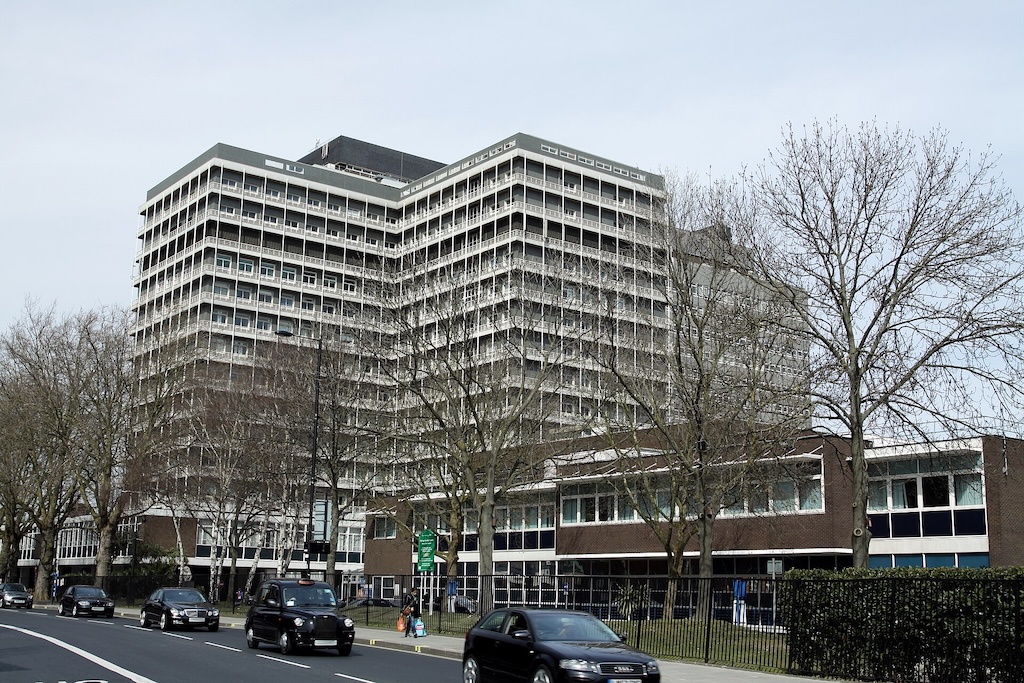 Charing Cross Hospital in London. Photo Credit: © Chmee2 via Wikimedia Commons.
The Royal Free Hospital is located in Hampstead and treats patients from the north of London. It was originally situated in the Gray’s Inn area of London and was founded in 1828 by a surgeon who was distressed that nobody would care for a girl who died soon afterwards. It moved to Hampstead in the 1960s as the Gray’s Inn site was becoming too cramped. The Royal Free now has over 800 beds and an A&E department.
One of the doctors who trained at the Royal Free was Andrew Wakefield, who reportedly identified a link between the MMR vaccine and the presence of autism in children. Although his findings have been widely discredited and Wakefield was struck off the Medical Register and is no longer allowed to practice medicine, his work has had a major effect. For a long time, the Royal Free was also the only teaching hospital in London that allowed women to train as doctors. One of the first was Elizabeth Garrett Anderson, an early suffragette.
The Royal London Hospital is situated in the East End of London, traditionally the poorest part of the capital. However, it is close enough to the City, traditionally the richest part of the capital, to offer treatment there as well as in Tower Hamlets, where it is situated. It is a large hospital on the Whitechapel Road with over 1200 beds and even a helipad.
The Royal London was founded in 1740 after seven men met in the Feathers Tavern in Cheapside. It was originally called the London Infirmary, later the London Hospital, and added the name ‘royal’ to its title after a visit by Queen Elizabeth II in 1990. The nurse Edith Cavell, who helped 200 allied prisoners to escape in the First World War, trained and worked at the hospital, and a blue plaque in her memory is sited there. Joseph Merrick, who was known as ‘the Elephant Man’ because of his facial deformities, was admitted to the hospital in his later years and died there. His skeleton (which is not on public display) is kept there.
A letter to the hospital was sent by a man purporting to be Jack the Ripper in 1888. No one has ever identified the killer, although many theories have been put forward, and some doctors from the Royal London, who examined the corpses of the victims, believed that he had some anatomical knowledge. The Royal London was near the centre of the crimes.
On a lighter note, the popular British television series Casualty and Call the Midwife were filmed at and near the hospital. Call the Midwife shows the life of midwives in the East End of London, and Casualty tells stories of life in a typical London hospital in the present day.
Doctor John Barnardo trained at the Royal London. Although he never completed his studies, he was called ‘Doctor’ throughout his life and later founded a series of homes for poor and deprived children. During his lifetime, it supported 60,000 children, and the work of Barnardo’s, as it is now known, continues with the charity raising over £200 million a year.



Leave a Reply