



On a cold, windy night, I am leaving Soho. Outside, I pause to check my messages (as tourist guides should always do), and that is when it happens. For an instant, I feel a shove, sharp enough to make me step back…but when I turn, there is no one there. Except him. He is already halfway down Great Pulteney Street, slipping into a wrought iron doorway I swear was not open a moment ago. My curiosity spikes and I move closer to look inside. From a window, a thin candle burns with a trembling, unnatural light as if it knows I am watching. Then the figure appears again. He blows out the candle, and suddenly he is right in front of me. He presses a book into my hands. Before I can speak, he is gone. Not walking away. Gone. On the wrapping, a message written in a hurried, slanted hand.
‘I wrote The Vampire…’ John William Polidori. The ink is still wet. As I open the first pages, a strange urge hits me. I need to know who this author really was as if the book is asking for me to look deeper.
John William Polidori was born on the 7 September 1795 in Westminster. His father, Gaetano Polidori, came from the village of Bientina near Pisa. A writer and scholar of Greek descent, Gaetano studied law at the University of Pisa and occasionally wrote poems and essays. He also collaborated with the dramatist Vittorio Alfieri and became his secretary in 1785. With him he travelled through Alsace and later moved to Paris where they lived together for four years. Eventually, tired of his duties and of France, Gaetano left in search of a new life and arrived in England in 1790.
He settled in Highgate, working as an Italian teacher and translator, soon gaining a reputation for being ‘the most esteemed Italian teacher in England’. He married Ann Mary Pierce, an Anglican and a private governess to wealthy families. He devoted himself to typography, establishing a private press in his home where he printed various works, including many of his own. His third daughter, Frances Mary Lavinia (1800–1886), married the Abruzzese poet and political exile, Gabriele Rossetti. Their marriage produced three children, two of whom would later become central figures in British cultural history: the painter and poet Dante Gabriel Rossetti and the poet Christina Rossetti.
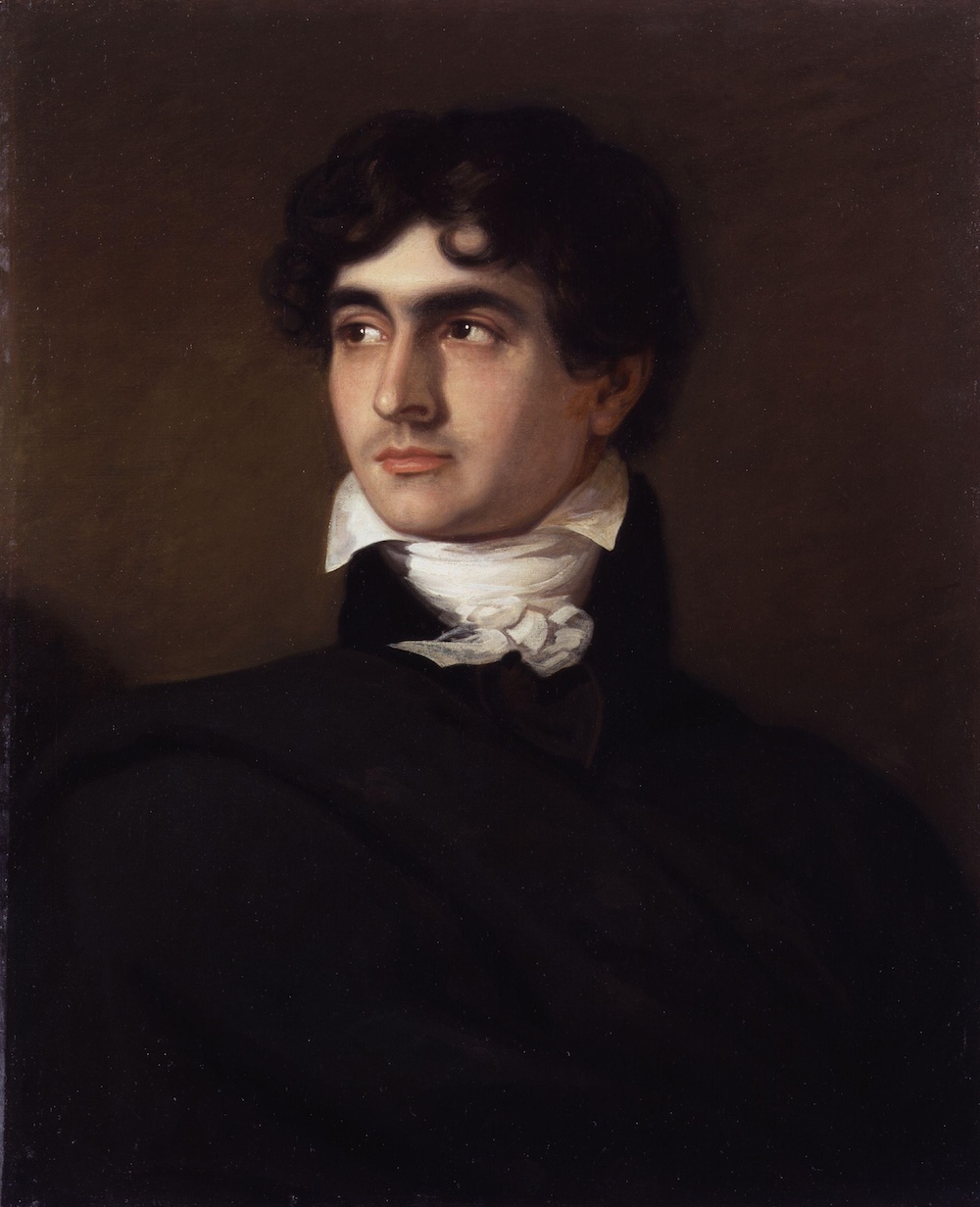 Portrait of John William Polidori, by F.G. Gainsford. Photo Credit: © National Portrait Gallery: NPG 991 via Wikimedia Commons.
Gaetano supported his grandchildren wholeheartedly, publishing their early poetic works on his private press. By the time of his death in 1863, his dedication, talent, and perseverance had made him a charismatic and influential figure within the Anglo-Italian community. John, his eldest son, was educated at Ampleforth College in Yorkshire. The school was originally a Benedictine convent built on land donated by Anne Fairfax, remembered for her sharp remark during the trial of Charles I, when she excused her husband’s absence by saying, ‘he had more wit than to be there’, a comment that led to her expulsion from the royal court! Ampleforth would later educate notable figures, including the actor Rupert Everett and the sculptor Antony Gormley.
A gifted and disciplined student, John later enrolled at the University of Edinburgh, where he pursued medical studies. In 1815, at only nineteen years old, he graduated as a Doctor of Medicine, one of the youngest people to gain a University degree. The year after he entered Lord Byron’s service and was hired as personal physician and scribe. Byron had already travelled through Europe, concentrating on the Mediterranean where he gained the inspiration for the first two cantos of his famous poem Childe Harold’s Pilgrimage. Byron’s second trip in 1816 became essential to escape England, where his growing fame had begun to interfere with his private life. Gossip was spreading about the collapse of his marriage with rumours of an incestuous affair with his half-sister, accusations that he had forced non-consensual acts upon his wife, and claims that he had been involved with actresses and prostitutes and corrupting his page boy. The first stop was in Belgium where he and Polidori visited the site of the Battle of Waterloo in a carriage modelled after Napoleon’s. A minor tension started to grow between the two men and Byron often teased and overshadowed the ambitious young doctor, creating considerable friction.
They arrived in Switzerland where the poet rented Villa Diodati on Lake Geneva and met Mary Wollstonecraft Godwin, and her husband-to-be, Percy Bysshe Shelley, with their companion (Mary’s stepsister) Claire Clairmont. They were also escaping England to avoid the publicity of their complicated relationship. Shelley had recently abandoned his wife for Mary and was having an affair with Claire, who got pregnant with his child. This was in 1816, known as the Year Without a Summer because of the massive volcanic eruption of Mount Tambora, Indonesia which had caused severe climate abnormalities in the rest of the world. One night, when a violent thunderstorm forced the travellers to remain indoors, Byron devised a way to entertain his guests. After reading aloud Tales of the Dead, a collection of horror stories, he proposed that each of them should write a ghost story. During that long, intoxicating night, with opium pipes being passed around, vials of laudanum scattered across the tables and carafes of red wine, the foundations were laid for themes of terror that would later shape universal literature and, eventually, the cinema,
Byron had already been inspired by tales of myth and legends during his first trip to Europe and wrote a few pages of a story about an English aristocrat who comes across a vampire in Turkey. It would later be published as The Burial: A Fragment. Polidori’s attempt to contribute with a tale about a voyeur horrified to discover that the woman he was watching had a skull instead of a face was not welcomed with great enthusiasm. Meanwhile, Mary began developing the idea that would eventually become Frankenstein. Even Shelley joined in the teasing of Polidori and the atmosphere grew very uncomfortable for him.
Disillusioned and irritated by the snobbish circle, Polidori found a way to escape the boredom by rowing across the lake to attend the more welcoming gatherings organised by Countess Breuss. There he met Madame Brelaz, who listened patiently to his troubles and became something of a private confidante. She encouraged him to pursue his literary ambitions. He admitted to finding the Byron tale inspiring and this would probably be the reason why he would be associated with the most famous mystery novel ever published which was called The Vampire where the main character, Lord Ruthven, is a fascinating aristocratic vampire. The same name was used by Lady Caroline Lamb to refer to Lord Byron in her work Glenavon.
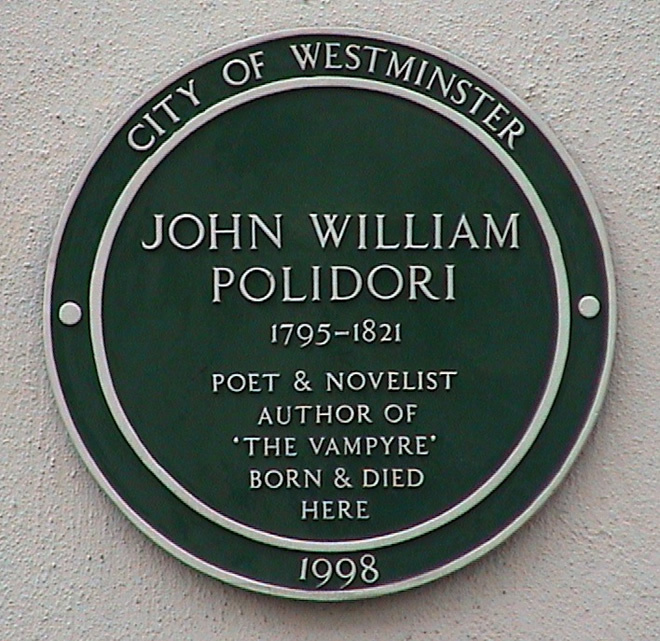 Memorial plaque for John William Polidor. Photo Credit: © London Remembers.
In the meantime, in Villa Diodati, things deteriorated further when John, neglected by Byron, became jealous of Claire, who kept flirting with the poet and Shelley. Byron eventually solved the tension by dismissing John who packed his bags and left for Italy. Back in England, he wrote to the Prior of Ampleforth, hoping to embark on an ecclesiastical career. But the events in Geneva had already become the subject of gossip, and the Prior, influenced by the rumours, replied with a dismissive tone and rejected him outright.
As events began to resemble the unfolding of a thriller, there was a third man included in this labyrinth. His name was Alaric Alexander Watts, a British poet and journalist, working as a sub-editor for Henry Colburn, the New Monthly Magazine’s director, who played a pivotal role in the publication of the novel probably after having consulted with Polidori. He handled the manuscript and initially tried to protect its true authorship, resulting in a conflict with Colburn. He also wrote a statement for the publication, stating that, while the tale was not directly by Byron, it was ‘conceived’ by him and based on his ideas. In the meantime sales of the journal and the novel soared.
Colburn, aiming to boost sales even more, by keeping the Byron attribution, cancelled this statement without Watts’ consent. In response Watts resigned, refusing to be part of the deception. Despite his initial frustration, Watts is described as having introduced the tale with his own notes on vampire beliefs in various publications throughout the nineteenth century. He remains a key figure in the literary landscape of the day, known for editing annuals like The Literary Souvenir and his involvement in this case highlight’s the period’s fierce competition for sensational content and the emerging market for high-profile cultural gossip. Polidori was vilified by the Byron circle and this ultimately wrecked his career as a writer.
The tale was then published in book format but there was no mention of the writer and the novel was introduced by the poem Mazeppa which was written by Byron. Polidori, weighed down by depression and gambling debts, committed suicide, by means of prussic acid in August 1821 at the age of twenty-six in Highgate and was buried at St Pancras Old Church in Camden. Despite strong evidence of suicide the coroner gave a verdict of ‘death by natural causes’. Polidori’s sister Charlotte made a transcription of the diaries of his time with Byron. She censored ‘peccant passages’ and destroyed the originals. The Diary of John Polidori was edited by his nephew William Michael Rossetti and published in 1911.
Although Polidori had a tragic end, what he could not have known was that his version of the vampire story sparked a trend which would last to this day. We have Bram Stoker’s Dracula and the Twilight series. An adaptation appeared in 1820 with Cyprien Bérard’s novel Lord Ruthven ou les Vampires. Nikolai Gogol, Alexandre Dumas and Aleksey Tolstoy all produced vampire tales. Dumas makes explicit reference to Lord Ruthven in The Count of Monte Cristo. There were also movie adaptations: The Vampire’s Ghost in 1945 and The Vampyre: Blood & Ink, starring Malcolm McDowell and Derek Jacobi.
Pino Pastore


Leave a Reply