



Blue plaques celebrate individuals whose lives and work helped shape London’s intellectual, cultural, and social landscape. English Heritage, which awards plaques, invites people to nominate those worthy of recognition. However, they say that blue plaques are only given to those who have been dead for twenty years. So, for example, there are no blue plaques for Paul McCartney and Ringo Starr of the Beatles, who are very much alive at the time of writing. However, there are plaques for John Lennon and George Harrison. These are in Baker Street, where the group had the first Apple Corps Headquarters. Likewise, there is no plaque for David Bowie, although an unofficial one has been put up on his house in Bromley. When he is honoured, it will probably be at his birthplace in Brixton. (He died in 2016.)
 English Heritage logo. Photo Credit: © English Heritage.
English Heritage are keen to correct the imbalance in the representation of women in blue plaques. When they took over the scheme in 1986, they honoured only forty-five women with plaques and, currently, just fifteen per cent of plaques are for women. Amongst women commemorated recently are fashion designer Jean Muir, artist Barbara Hepworth and Diana Beck, who is thought to be Britain’s first female neurosurgeon. Recent female recipients include the former astronomer Cecilia Payne-Gaposchkin, whose groundbreaking discoveries transformed our understanding of the stars, and the actress Audrey Hepburn. She starred in many films, such as My Fair Lady, in which she played Eliza Doolittle. The film is set in Covent Garden, London. Other women honoured with a blue plaque include fashion designer Jean Muir, artist Barbara Hepworth, and Diana Beck, thought to be Britain’s first female neurosurgeon.
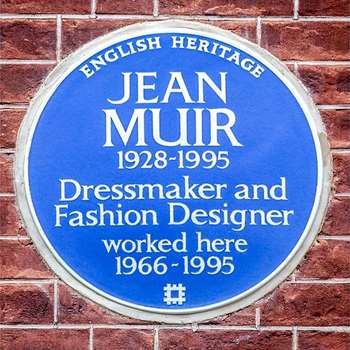 Jean Muir Blue Plaque in London. Photo Credit: © English Heritage.
Another famous actor, Laurence Olivier, is remembered with a blue plaque at his childhood home in Lupus Street, Pimlico. It was unveiled by the actor Sir Ian McKellen.
English Heritage is also keen to promote LGBTQ people such as McKellen. Although figures do not exist for the number of LGBTQ people honoured in this way, English Heritage have dedicated a part of its website to prominent people from this community. Amongst them are Oscar Wilde, who is remembered with two plaques. In Tite Street, Chelsea, where he lived and at Clapham Junction station, where he was subjected to a well-remembered bout of hatred. Even the Roman emperor Hadrian is honoured.
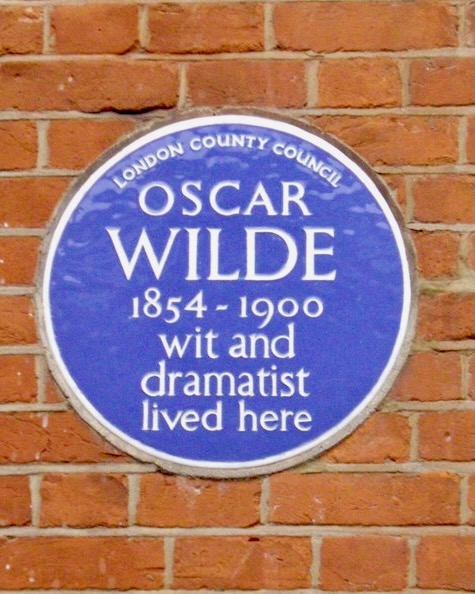 Oscar Wilde Blue Plaque in London. Photo Credit: © PAUL FARMER via Wikimedia Commons.
Rock stars are often recalled with plaques. Apart from Bowie (who will surely be given a plaque in the future) is his friend and rival Marc Bolan who died on Barnes Common in 1977 when a Mini he was a passenger in crashed. Bolan (whose birth name is Mark Feld) is honoured with a plaque on the house where he lived in Maida Vale. His funeral at Golders Green cemetery was attended by many rock stars such as Rod Stewart, Steve Harley, The Damned and hundreds of Bolan’s many fans.
Each blue plaque is entirely made by hand. From 1984 to 2015, Frank Ashworth made them at his studio in Cornwall, and his wife, Sue, inscribed them. Since 2015, Ned Heywood has made them in Wales.




Leave a Reply