



What – not another one? Yes, but not an election. This time it’s a tunnel – another one under London, from west to east, and this one is less in the news because it is all about our waste. After London’s population doubled between 1840 and 1900, Sir Joseph Bazalgette’s literally ground-breaking tunnel, his great Intercepting Sewer, saved London from the Great Stink of 1856. It has taken London a bit longer to re-double its population again but we are facing the same smelly problem. Thames Water was recently fined an eye-watering sum of over two billion pounds because of storm-water overflows into the Thames tributaries. They are now tackling the problem by building an intercepting container – the Thames Tideway Tunnel.
The Thames Tideway Tunnel will run from Acton in the west to Beckton Treatment works in the east and then on to the splendid Abbey Mills Pumping Station at Stratford. You may have noticed the rig in the Thames at Blackfriars, where work began last October, one of twenty-four sites across London where work will take place. The tunnel will be twenty kilometres long, with a depth of sixty metres, and will mainly follow the river. At 7.2 metres in diameter, it will be used to hold up to thirty-nine million tons of storm-water run-off before treatment. When clean, the water will be released back into the Thames. A further tunnel will be built at the river Lee as well as upgrades to a number of other sewage treatment works. It will take seven years to build and will cost Londoners an eighty-pound annual supplement on our water bills until 2020, which will go towards the £4.2 billion total cost.
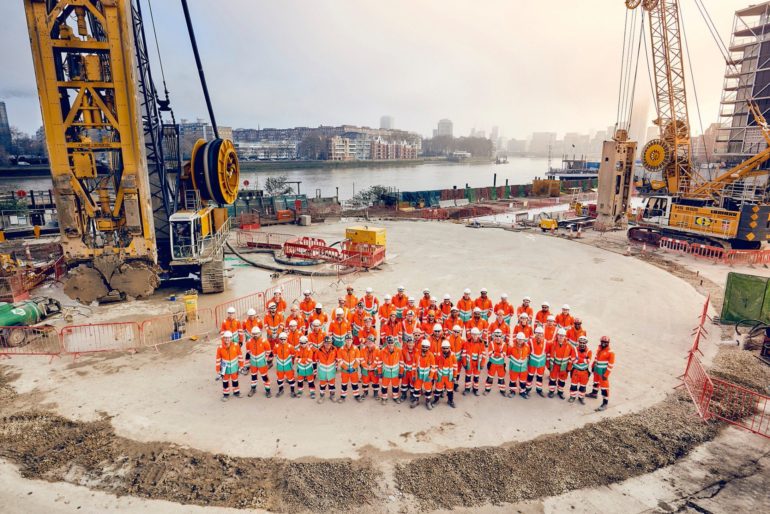 Tideway workers have begun work on digging a hole with a 30m diameter on the banks of the River Thames to create the Thames Tideway Tunnel known as London’s “super sewer.” Photo Credit: © Thames Tideway Tunnel.
It has already proved almost as controversial as the first tunnel built in 1868. There have been protests at the loss of riverside parks for work areas and about the increase in traffic, noise, and pollution around the sites in Hammersmith and Southwark. The cost has also been contested with claims that cheaper and greener solutions could solve the problem. Because so much of London has been concreted over, there are fewer areas where rainwater can soak away. This has been partially tackled at the huge Nine Elms development, where a surface water management scheme has been included, but rainwater overflows remain a problem. Thames Water has promised to use the river to move materials as much as possible to reduce road congestion.
So far, the rig at Blackfriars is the most visible sign along our routes, but soon, they will be popping up at Chelsea Embankment, Albert Embankment, at Chambers Wharf just past the Tower, and at Wapping, Deptford, and Greenwich. The name of the company that will build, maintain and operate the new tunnel? Bazalgette Tunnel Ltd. Just don’t mention the sewerage.




Leave a Reply