



The new £10 is the second plastic or polymer note issued by the Bank of England and features a portrait of Jane Austen. It follows the introduction of the first polymer note in September 2016, a fiver with a picture of Winston Churchill and an extract from his famous speech: ‘I have nothing to offer but blood, sweat, tears and toil.’ The new twenty-pound note, with a portrait of a young J. M. W. Turner and a version of his painting of the Fighting Temeraire in the background will be released in March 2020. As yet no decision on a polymer fifty-pound note has been made and who would feature on it.
The Bank of England followed countries such as Canada and Australia in introducing polymer notes with the slogan ‘Cleaner, Safer, Stronger’. They last two to three times as long as paper ones and, with colour-changing holograms, are almost impossible to forge. Check out Jane Austen Banknote Unveiled at Winchester Cathedral for more on the Jane Austen £10 and the Bank of England website.
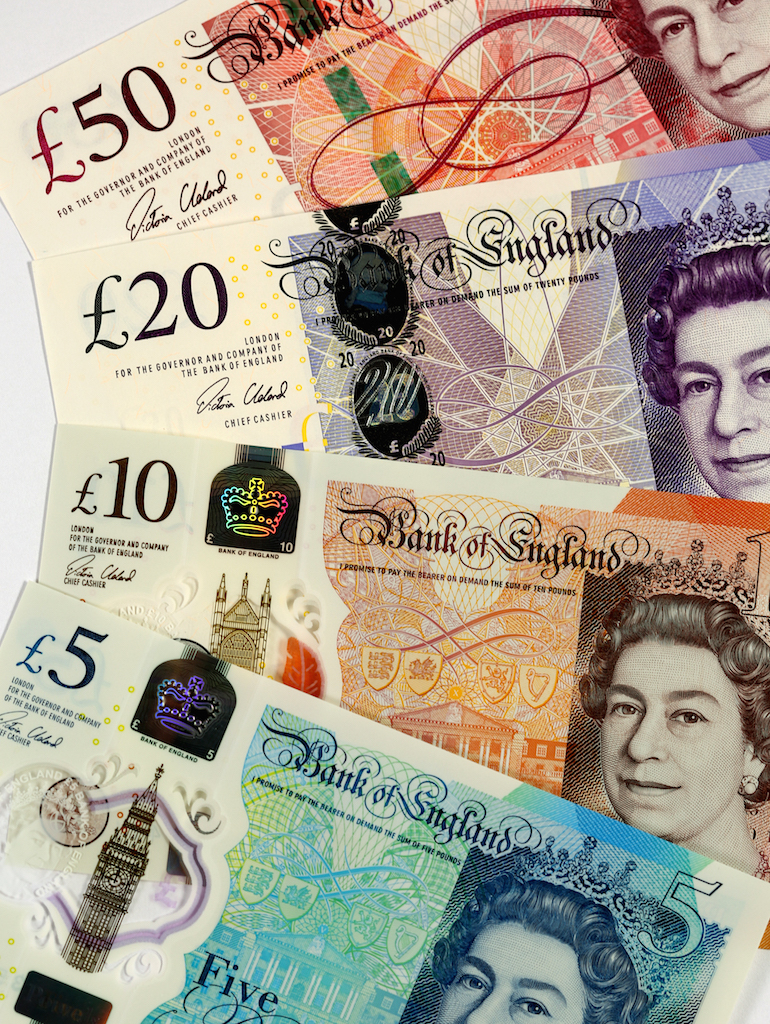 Bank of England: Polymer Notes
Forgery was also an issue with the pound coin. It is estimated that around three per cent of the billion and a half pound coins in circulation are forgeries. This will not be possible with the new twelve-sided bi-metallic coin which has a holographic image showing a ‘£’ or a ‘1’ symbol depending on which angle it is looked at. This feature is just below the head of the Queen, the fifth image of her seen on our coins. It was designed by Jody Clark, at thirty-three the youngest person to design an image of Her Majesty on our coins and the first Royal Mint engraver to do so in over 100 years.
On the other side of the pound coin is a design by fifteen-year old Walsall schoolboy David Pearce which incorporates the flowers symbolising the four countries of the UK enclosed within a coronet: a rose for England, thistle for Scotland, leek for Wales and shamrock for Northern Ireland. This was one of 6,000 entries submitted to an open competition launched by the Royal Mint Advisory Committee.
The old pound coin ceases to be legal tender at midnight on 15 October. There have been many designs on these coins featuring the royal coat of arms; plants representing the countries of the UK: thistle, leek, flax (Northern Ireland), oak tree (England); animals such as the lion rampant (Scotland), three lions passant (England), dragon (Wales); the Celtic cross (N.I.) and bridges from each country (the Forth bridge in Scotland, Menai bridge in Wales, the Egyptian arch bridge in Northern Ireland and Gateshead Millennium bridge in England).
Shops and businesses can refuse old notes and coins when they cease to be legal tender. The Bank of England will always redeem them so they can still be deposited in bank accounts.





Leave a Reply