



Buckingham Palace, the official residence of the British monarch, is one of the highlights of any visit to London. Did you know that just beside the palace are the Royal Mews, which you can also visit? The Mews are where the Royal Family have kept their fine horses and elegant carriages for centuries and where they have parked their luxury automobiles since Edward VII purchased the first royal car in 1901.
The Royal Mews began behind the palace in 1761 when George the Third moved some horses and carriages from the Royal Mews at Buckingham House, which he purchased from Sir Charles Sheffield, the illegitimate son of the 1st Duke of Buckingham. The Riding School which can be seen just before the exit is the oldest part of the complex and dates back to George’s reign. Changes made by successive monarchs included the introduction of cars. King Charles III is making the garage more carbon-friendly by having gas lamps converted to electric ones and installing charge pods for electric cars. A claret-coloured Range Rover in the car park has the licence plate ‘MYT 1’. It reads as ‘Mighty One’ and was first used by Queen Elizabeth II in the 1960s.
Around 200 people live in the Mews. Some families have been there for several generations, though this is not as common as it once was. The mews community includes masters and apprentices in carriage restoring, saddle leatherwork, farriers and other relevant trades. There are about twenty coachmen, grooms and liveried workers who work with the thirty horses normally based there.
Resident horses – the Windsor Greys and Cleveland Bays – practice pulling carriages every day by carrying the post from Buckingham Palace to St James’s Palace early in the morning. When a new ambassador or High Commissioner arrives, a horse-drawn carriage is sent to take them to St James’s Palace to present their credentials. You will always see at least two horses in the stalls at the mews though they take a six‐week annual holiday in Windsor on rotation.
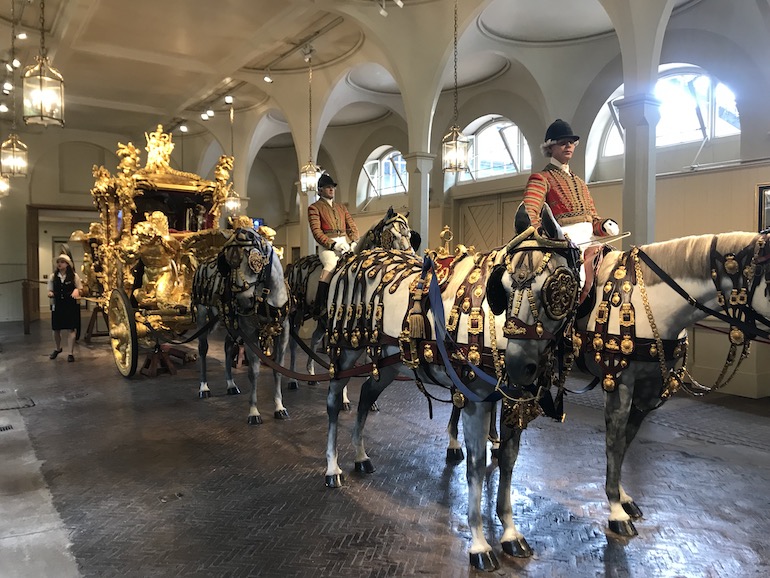
Gold State Coach at Royal Mews in London. Photo Credit: © Edwin Lerner.
Here are a few of the stories on the vehicles:
The ‘everyday’ King Edward VII Town Coach (1902) is the only remaining coach of a fleet of seventeen that he ordered for transporting VIP guests. He never sat in it himself because it was delivered after he died. His consort used the glamourous ‘wife coach’ known as Queen Alexandra’s State Coach for social occasions for many years. It is adorned with sixty-seven crowns!
Lady Diana Spencer took The Glass Coach (1881) – also known as ‘the marriage carriage’ because it has conveyed so many royal brides – to St Paul’s Cathedral on her wedding day. When she asked the ex-military man in charge if she could be late, like a typical bride, and for the drama; he looked at his stopwatch and held it for precisely thirty seconds before saying ‘Go!’
Queen Elizabeth II was meant to ride into the 2012 Olympic stadium at the Opening Ceremonies in the Diamond State Coach (2014) but it was not ready in time – hence the memorable sight of her parachuting in with James Bond. It is a time capsule on wheels with dozens of historic items incorporated into the structure. The crown on top is made of wood from Nelson’s ship HMS Victory.
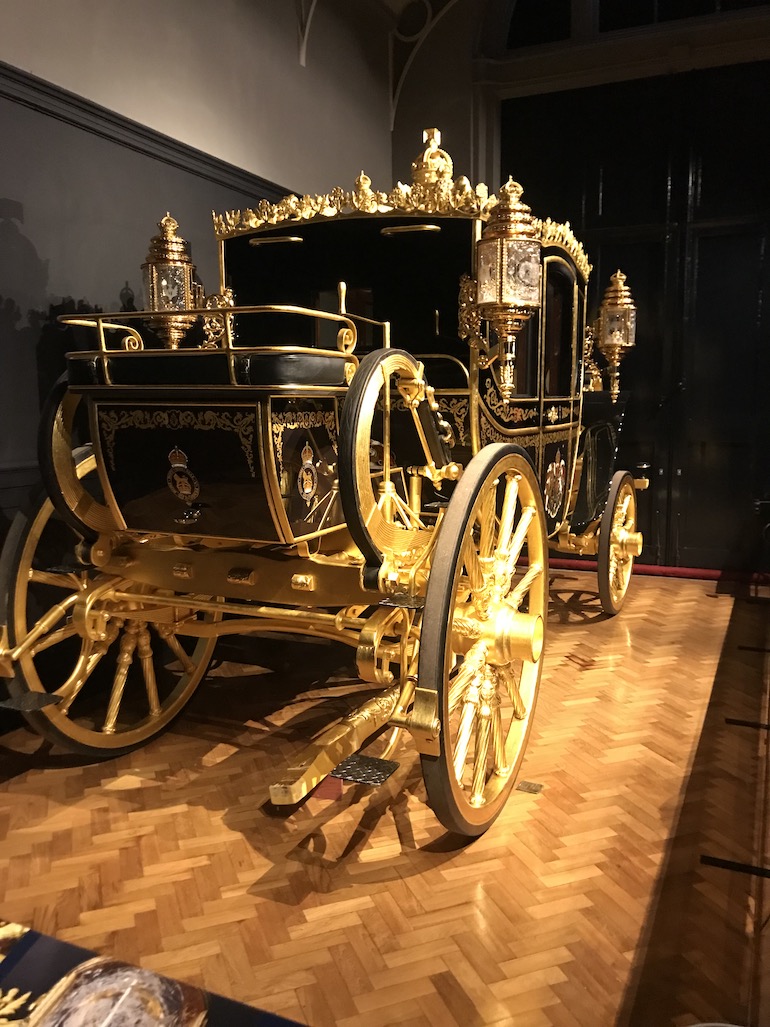
Diamond Jubilee Coach at Royal Mews in London. Photo Credit: © Edwin Lerner.
The Gold State Coach weighs an incredible four tons and stretches seven metres. It is richly decorated with gilded wood carvings and painted canvas panels. You really have to see it to believe it. It was commissioned by George III and designed by William Chambers, the architect behind the Riding School. Although he had previously designed the Lord Mayor’s Coach, Chambers focused more on visual impact than comfort. When drawn by eight horses it sways from side to side stabilised just by some leather straps. William IV, who spent much of his life in the Navy, said riding in it felt like being at sea. George III was the first to use the Gold State Coach, though his experience was far from smooth; the door handle on his side fell off, forcing him to climb over Queen Charlotte to get out first.
Taking the coach out is a careful operation. It is stored at a right angle to the exit. To bring it out, the doorframe and even the window above must be removed. It is then slowly manoeuvred to make a tight ninety-degree turn. Given the narrow door aperture, a little extra gold paint is always kept nearby in case of the occasional scratch.
Several horses, carriages, and members of staff have temporarily moved from the Royal Mews in London to those in Windsor, a change expected to last until autumn 2027. With Buckingham Palace undergoing essential servicing, Windsor is the venue for upcoming state visits and so this is where the horses and carriages are needed. The Irish State Coach has been replaced with The Charabanc, while the Scottish State Coach has been replaced by the State Sleigh and the French Chaise.
The Charabanc (1844) is a large open-sided carriage with an awning dripping with tassels. Charabanc comes from the French term ‘char-à-bancs’ which means ‘carriage with benches.’ It has four rows of bench seats all facing forward and covered in fine cream silk. Queen Victoria would fill the benches with her large brood and take them for a ride around the grounds at Osborne House. In 1843, she had visited France and admired the char-à-bancs of King Louis-Philippe and so one year later he sent this one to her as a gift. Victoria loved it so much that it was included in her funerary procession, for which it was painted black. After a four-year restoration it is a gorgeous blue inspired by the French royal colours. Shortly after the restoration in July 2025, the carriage was displayed at Windsor Castle during the state visit of President Macron as a symbol of Anglo-French friendship.
The State Sleigh (1845) was designed by Prince Albert and the carriage designer John Gilfoy, who took inspiration from German sleighs. It was made in London by Hooper & Co and first used on a snowy outing in Brighton that Queen Victoria described in her diary. Santa himself has borrowed it when meeting children at Clarence House at the invitation of Queen Camilla.
The French Chaise (1875) was given by the future King Edward VIII to the future Queen Alexandra for her use at Sandringham while he was on a long tour in India. Princess Elisabeth, later Queen Elizabeth II, and her sister Princess Margaret drove it at the Royal Windsor Horse Show in 1944 and 1945 – the former winning awards for her driving! More recently, Lady Louise Windsor has used it in driving competitions (‘classes’) at the show.


Leave a Reply